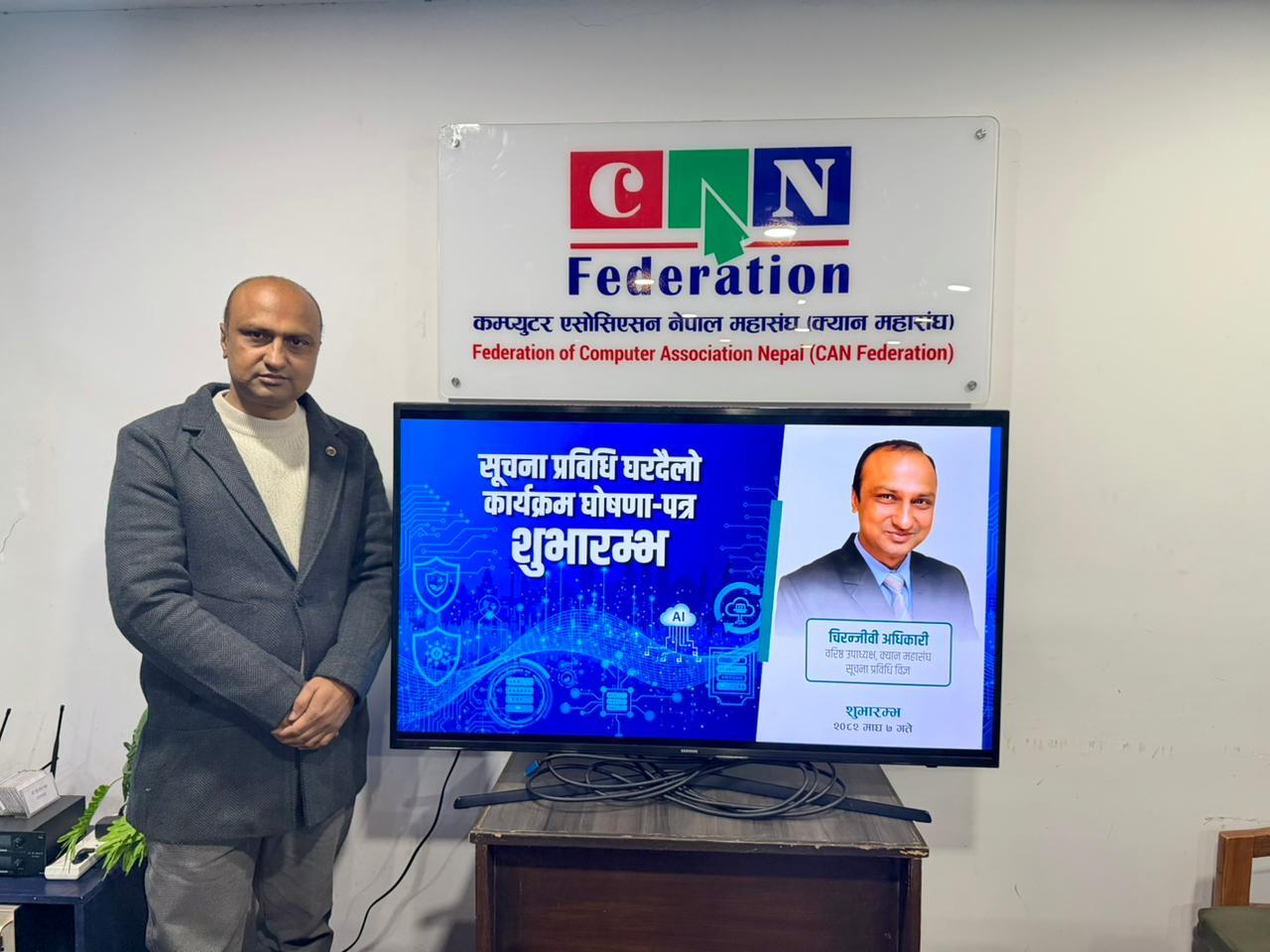
Kathmandu – Nepal’s rapidly evolving Information Technology (IT) sector is set for significant reform with the launch of the “Information Technology Door-to-Door Journey” campaign by Mr. Chiranjibi Adhikari, Senior Vice President of the Federation of Computer Association Nepal (CAN Federation) and a leading cybersecurity expert. The campaign seeks to address long-standing challenges within Nepal’s IT sector, reform outdated policies, and promote the growth of startups across the country.
Background and Campaign Objective
Nepal’s IT industry has experienced substantial growth in recent years, with IT companies and startups emerging beyond Kathmandu to cities like Butwal, Dharan, and Janakpur. Despite this growth, several challenges remain. The government’s ambitious Digital Nepal Framework, which promises to prioritize digital infrastructure, e-governance, and innovation, has faced slow implementation due to outdated legal frameworks, policy ambiguities, and poor coordination among government agencies.
Mr. Adhikari’s “door-to-door” initiative, launched on his birthday, is designed to bring the voices of the IT sector directly to policymakers. The campaign will focus on identifying critical problems within the IT industry, such as legal and policy gaps, and push for reforms that align with the needs of today’s technology-driven economy.
The Need for Policy Reform
The backbone of Nepal’s IT sector is the Electronic Transactions Act, 2063 (2006), which was groundbreaking at the time but is now outdated. It fails to address emerging technologies such as Artificial Intelligence, blockchain, cloud computing, and big data. Mr. Adhikari emphasizes the urgency of updating these laws to foster an environment conducive to startup growth and to attract foreign investment.
“We have the talent and innovative ideas, but outdated laws are limiting our potential,” Mr. Adhikari stated. “The dream of Digital Nepal will remain just that unless we modernize the legal framework and adopt clear policies that encourage technological growth.”
Challenges in IT Infrastructure and Data Management
One of the campaign’s primary focuses is the absence of a centralized and secure data exchange platform. At present, citizens must repeatedly submit the same information when accessing government services due to a lack of integrated systems. Mr. Adhikari’s campaign seeks to advocate for the creation of a secure data exchange platform that would streamline government services, reduce corruption, and enhance efficiency.
Nepal also faces a critical shortage of data centers, with sensitive government and private sector data often hosted on foreign servers, raising concerns over data sovereignty and national security. Cybersecurity experts warn that this dependence on foreign servers exposes Nepal to cyberattacks and political vulnerabilities.
Focusing on Startups and Innovation
The campaign aims to visit over 100 IT companies, including startups, software development firms, cybersecurity companies, and fintech institutions, to understand the challenges they face. These challenges include limited investment opportunities, bureaucratic government procedures, tax issues, and intellectual property rights concerns.
Startup entrepreneur Mr. Sumit Shrestha emphasizes that while Nepal possesses strong technological capabilities, government support is essential for competing in international markets. He said, “The ‘door-to-door’ campaign will deliver our real problems to policymakers. This is a major opportunity for youth.”
Cybersecurity and National Security
In the digital age, cybersecurity is not only a technical issue but also a matter of national security. The campaign will prioritize cybersecurity, focusing on strengthening Nepal’s national cybersecurity policy, improving the Computer Emergency Response Team (CERT), and developing a workforce capable of tackling modern cyber threats.
Ms. Manju Shah, Head of Nepal’s Cybersecurity Department, noted, “While we have policies in place, implementation has been challenging. The ‘door-to-door’ campaign will connect policy, law, and startup experiences to find practical solutions.”
Advocating for Digital Commitments in the 2026 Elections
As Nepal prepares for the 2026 elections, the campaign aims to ensure that political parties prioritize IT and digital infrastructure in their manifestos. In previous elections, the IT sector was often sidelined, but Mr. Adhikari’s initiative seeks to make the digital economy, cybersecurity, and technology-based employment central to national development.
Digital communication expert Mr. Ujjwal Acharya pointed out that technology now dominates both the flow of information and the economy. However, the improper use of social media has led to challenges such as trolling, cybercrime, and hacking risks. The campaign calls for long-term cybersecurity solutions as part of political parties’ digital commitments.
The National Information Technology Manifesto
The findings and recommendations gathered from the campaign will culminate in the creation of a National Information Technology Manifesto. This long-term roadmap will be formally submitted to the government and political leaders, outlining the policies, laws, infrastructure, and innovation necessary for the realization of Digital Nepal.
Conclusion: A Milestone in Nepal’s Digital Journey
Chiranjibi Adhikari’s “Information Technology Door-to-Door Journey” campaign represents a pivotal moment in Nepal’s journey towards becoming a digital economy. By addressing challenges faced by IT companies and startups, advocating for policy reforms, and emphasizing the need for cybersecurity, this initiative aims to create a competitive and sustainable IT ecosystem.
The campaign is expected to play a critical role in realizing the dream of Digital Nepal, ensuring that Nepal’s youth are equipped for technology-based employment, promoting innovation, and improving government efficiency. As Nepal moves forward, this campaign is poised to become a significant milestone in the country’s digital transformation.