
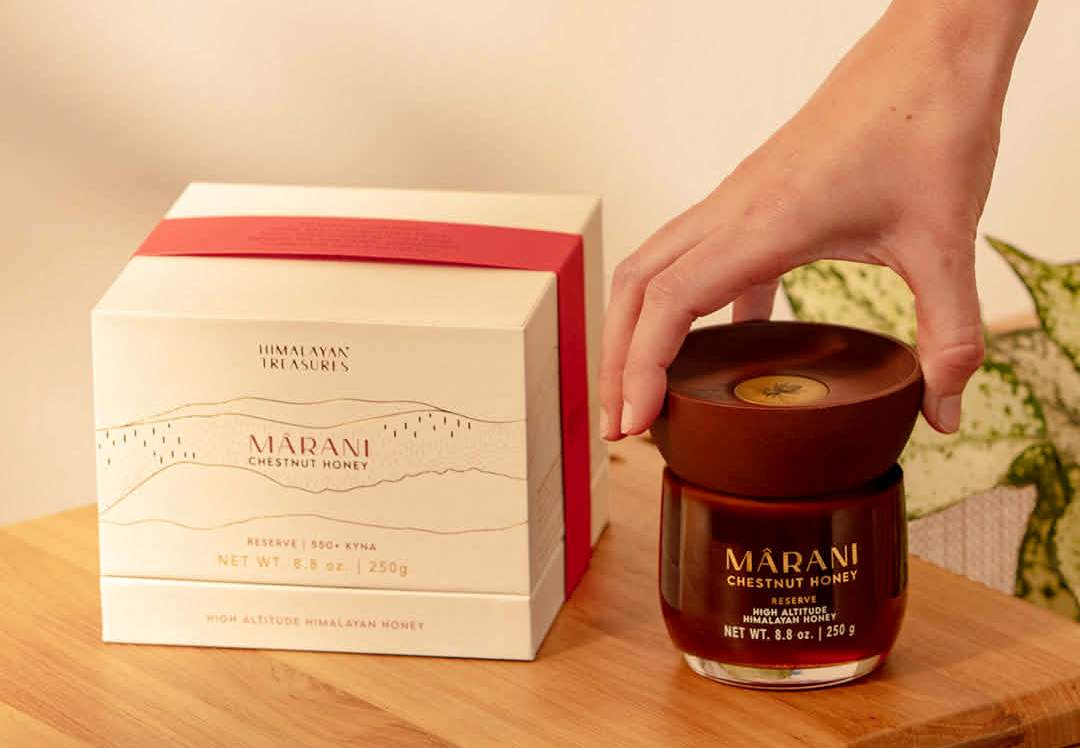
The global market has been introduced to Surya Nepal’s premium chestnut honey under the newly registered ‘Marani’ brand. Sourced from Nepal’s high mountainous regions, the honey is now being exported to the United States, marking a significant achievement for Nepal’s agricultural products.
The ‘Marani’ brand has been registered in Nepal, with the honey being processed according to international quality standards. The product is packaged in 250-gram jars and priced at 83 US dollars. The processing of the honey is carried out at Surya Nepal’s facility in Budhiganga Rural Municipality-2, Morang, where stringent quality control measures are ensured.
Historically, Surya Nepal has been known for producing biscuits and confectionery for the domestic market. However, the product portfolio has been expanded to include premium honey. The ‘Marani’ honey brand has been produced since Chaitra 2082 (March 2026), with a focus on the US market. The ‘Marani’ brand is considered an embodiment of Nepal’s Himalayan agri-luxury, offering a unique and high-quality product to global consumers.
The company’s Managing Director, Gaurav Tayal, emphasized the importance of preserving Nepal’s identity through its products. “Honey is not just being packed; the best of Nepal’s identity is being preserved. Each product is developed actively to uphold the integrity and quality of the region,” Tayal stated.
The commitment to quality has been supported by Surya Nepal’s institutional capacity and scientific certification, while efforts are being made to establish a strong global presence for Nepali agricultural products, particularly in the honey sector.
Raw honey is sourced from indigenous bees in the remote areas of Tanahun and Lamjung districts, as well as Mugikot and Dagam. Initially, 150 local farmers have been involved in the production, with plans for expansion to over 2,000 farmers.
The facility in Morang is capable of processing 100 tons of honey annually, with production expected to increase as export demand grows.
Despite Nepal’s rich biodiversity, challenges in establishing a “premium footprint” in the global market have been highlighted. “Nepal has long struggled to create a ‘premium footprint’ globally. The best resources are often exported in bulk, losing their identity before reaching consumers,” the company explained.
The introduction of ‘Marani’ honey is part of a strategy to elevate Nepal’s agricultural products on the global stage. It is hoped that ‘Marani’ honey will be able to compete with world-renowned products such as New Zealand’s ‘Manuka’ honey. “No compromise on quality has been made, and it is believed that our products can compete with the best in the world,” Tayal stated.
Each jar of honey exported to the US carries Nepal’s prestige and identity. American consumers will be able to purchase the product through platforms such as HimalayanTreasures.com and Amazon.