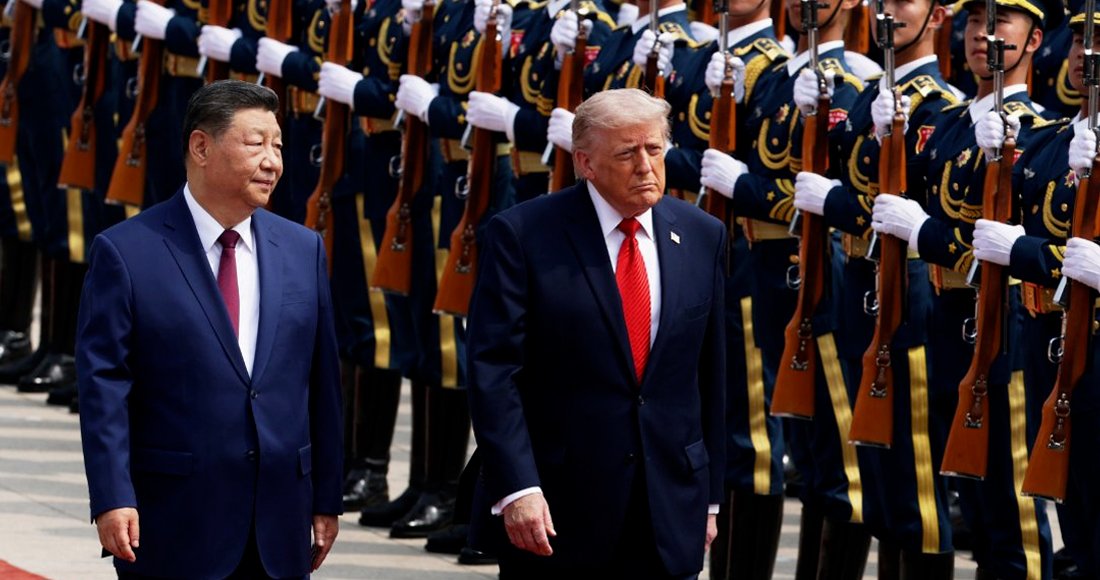
Kathmandu-High-level bilateral talks between the United States and China have officially begun at Great Hall of the People, in what analysts are calling one of the most significant diplomatic meetings in recent years. Chinese President Xi Jinping and US President Donald Trump are leading the two-day summit aimed at addressing growing tensions and shaping the future direction of relations between the world’s two largest powers.
In his opening remarks, President Xi welcomed Trump and the American delegation, stressing that China and the United States should be partners rather than rivals. He said the world is currently undergoing “changes unseen in a century” and described the international situation as increasingly unstable and unpredictable.
Xi raised the question of whether both countries could avoid the so-called “Thucydides Trap” and establish a new model of major-power relations. He emphasized that, as the world’s leading powers, China and the United States carry a shared responsibility for history and the future of humanity. Xi also congratulated the United States on the upcoming 250th anniversary of its independence.
The Chinese leader noted that the two countries share more common interests than differences, adding that one nation’s success should be viewed as an opportunity rather than a threat to the other. According to Xi, stable US-China relations would benefit not only both nations but also global peace, economic stability and development.
Responding to Xi’s remarks, President Trump described the meeting as “an honor” and recalled how both leaders had previously resolved difficult situations through direct phone conversations.
Trump praised Xi as “a great leader” and said he had arrived in China accompanied by some of the world’s top business and technology figures. He mentioned that some observers were calling the meeting “the biggest summit ever” and expressed optimism that relations between Washington and Beijing would become stronger after the talks.
Upon arrival in Beijing, Trump was welcomed at the airport by Chinese Vice President Han Zheng, a gesture widely interpreted as a sign of special diplomatic respect from Beijing. Trump’s delegation also includes his son Eric Trump as well as prominent business and technology leaders such as Elon Musk, Jensen Huang and Tim Cook.
According to Chinese state media, the US delegation also includes Secretary of State Marco Rubio, Defense Secretary Pete Hegseth, US Trade Representative Jamieson Greer and Treasury Secretary Scott Bessent.
Key issues on the summit agenda include the ongoing trade war, artificial intelligence, semiconductor technology, Taiwan’s security and tensions in the Middle East. Trade relations between the two countries have become increasingly strained in recent years. Bilateral trade, which reached around $690 billion in 2022, reportedly declined to nearly $415 billion last year.
The Trump administration is seeking to reduce America’s trade deficit with China, while Beijing hopes to gain wider access to advanced US chips and high-end technologies. However, analysts note that Washington’s bargaining power has weakened somewhat after previous tariffs failed to produce the desired results and China strengthened its control over rare earth minerals and semiconductor supply chains.
The Iran–Israel conflict is also expected to dominate discussions. China, one of the largest buyers of Iranian oil, has faced economic pressure due to instability in the Middle East. The United States is reportedly urging Beijing to use its economic and political influence over Iran, while China has signaled support for efforts to end the conflict.
Taiwan remains another highly sensitive issue in the talks. Beijing has expressed strong dissatisfaction after the US Congress approved a $14 billion arms package for Taiwan last year.
Political analysts believe Trump’s visit to China could become a defining moment in future US-China relations. The outcome of the summit is expected to have major implications for global politics, trade and international security in the years ahead.