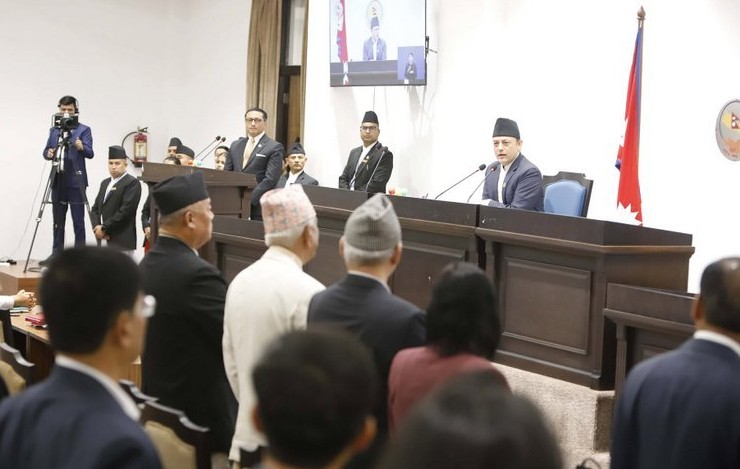
Kathmandu-The Government of Nepal’s Policy and Program for Fiscal Year 2083/84 has been officially passed by the House of Representatives, marking a key step in the annual budget and policy cycle. The decision was taken during a parliamentary session held on Thursday, where the document was endorsed by a majority vote despite strong protests, obstruction, and boycott from opposition parties.
The policy and program was earlier presented by President Ram Chandra Paudel in a joint sitting of the Federal Parliament. Following its presentation, the document moved through parliamentary procedures and was also endorsed by the National Assembly on the same day before reaching final approval in the House of Representatives. However, the process was marked by visible political polarization, as opposition parties demanded that the Prime Minister respond to questions raised on the policy document before its approval. Lawmakers from CPN-UML, Nepal Communist Party, Shram Sanskriti Party, and Rastriya Prajatantra Party (RPP) boycotted the session, while members of the Nepali Congress stood and obstructed proceedings.
Despite the disruption, the ruling side pushed the policy through a majority vote, highlighting both the government’s parliamentary strength and the continuing lack of consensus in national politics.
Economic reform at the core of the policy
At the heart of the FY 2083/84 Policy and Program is a strong focus on economic restructuring and revival. The government has proposed a review of the tax system, reduction of financial pressure on the middle class, and targeted relief measures for entrepreneurs and businesses. It has also announced amendments to foreign investment laws, aiming to attract greater international capital.
A key highlight is the introduction of an Investment Visa scheme, designed to encourage high-value foreign investors to bring capital into Nepal. The government has also emphasized the expansion of a cashless economy and promoted the concept of a “borderless economy and weightless trade,” signaling a shift toward more liberal, globally integrated economic policies.
Youth employment and startup push
The policy places strong emphasis on youth employment through the proposed “Startup Nepal” digital platform. This system is expected to allow one-day company registration, tax facilitation, and access to seed funding for new entrepreneurs. The initiative also aims to engage returnee migrant workers in productive sectors such as agriculture and small enterprises.
Additionally, the government plans to strengthen the information technology and innovation ecosystem, with the objective of building a more digital and knowledge-based economy. This reflects an attempt to address the persistent issue of youth unemployment and foreign labor migration.
Agriculture and rural economy transformation
Agriculture remains one of the central pillars of the policy. The government has proposed setting minimum support prices before crop cultivation, ensuring direct bank transfers to farmers, and promoting agricultural mechanization. It also plans to integrate agriculture with industry and markets to improve value addition and commercialization.
The policy clearly indicates a shift from subsistence-based farming to a more market-oriented and business-driven agricultural system. Rural economic revitalization is also highlighted as a major development priority.
Tourism and service sector expansion
In the tourism sector, the government has reiterated its long-term vision under the “Visit Nepal 2025” campaign. Plans include full digitization of tourist visa services, promotion of adventure tourism, integration of 5,000 homestays into digital booking platforms, and development of Nepal as an international film shooting destination.
These initiatives aim to strengthen tourism as a major source of foreign exchange earnings and employment generation, while also promoting Nepal’s global image.
Energy and infrastructure ambition
The government has set an ambitious target of generating 10,000 megawatts of electricity, reflecting its long-term energy expansion strategy. A unified transport master plan covering road, rail, water, and air transport has also been announced.
To address chronic project delays, the government plans to introduce a revised contracting system and ensure leadership continuity in development projects until completion. While these reforms aim to improve efficiency, implementation remains a key concern given past experiences.
Governance and anti corruption ,measures
Good governance remains a central theme, with the government reaffirming its policy of “zero tolerance on corruption.” It also plans to expand digital governance services, reduce administrative costs, and merge underperforming public institutions.
Additionally, a unified fund will be established to address the issue of cooperative sector victims, ensuring repayment of deposited savings. This move is seen as an attempt to restore public trust in the financial system.
Social sector commitments
The policy includes several social development commitments such as free secondary education, curriculum reform, improved foreign employment safety systems, and dedicated services for migrant workers. It also includes programs targeting women entrepreneurship, disability inclusion, and the elimination of street children.
While these commitments are socially progressive, concerns remain regarding fiscal capacity and implementation mechanisms.
Security and foreign policy direction
On security and foreign policy, the government has proposed resolving border issues through diplomatic channels, reforming security laws, and increasing domestic production of security-related materials. Disaster management will shift from a reactive approach to a more preparedness-focused system, aiming to improve national resilience.
Positive aspects of the policy
From a positive perspective, the FY 2083/84 Policy and Program presents a more structured and reform-oriented economic vision compared to previous years. The strong emphasis on startups, digital economy, investment attraction, and agricultural commercialization reflects an attempt to modernize Nepal’s economic structure.
The introduction of investment-friendly policies, cashless transaction systems, and youth-focused entrepreneurship programs are seen as forward-looking steps. Similarly, integration of tourism with digital platforms and expansion of renewable energy targets highlight long-term development ambition.
Negative aspects and criticism
Despite its ambitious outlook, the policy faces significant criticism. Opposition parties argue that many of the programs are repetitive and lack a clear implementation roadmap. Similar commitments such as corruption control, project acceleration, and institutional reform have been made in previous years but with limited visible results.
Experts also point to a persistent gap between policy announcements and actual execution. Large targets such as 10,000 MW electricity production and nationwide structural reforms raise concerns about feasibility given institutional weaknesses and resource constraints.
Political polarization during the parliamentary process further highlights governance challenges, raising questions about consensus-building and policy stability.
Overall, the Policy and Program for FY 2083/84 reflects a dual reality. On one hand, it presents an ambitious and modernization-focused vision centered on economic revival, youth empowerment, digital transformation, and investment attraction. On the other hand, it continues to face skepticism over execution capacity, policy repetition, and institutional readiness.
Analysts suggest that while the direction of the policy is positive and reform-oriented, the ultimate success will depend entirely on implementation, political coordination, and administrative efficiency.
As Nepal moves forward with yet another annual policy roadmap, the central question remains unchanged: will this policy translate into tangible economic transformation, or will it remain another set of well-written promises constrained by weak execution? For now, the answer lies not in the policy itself, but in how effectively it is implemented on the ground.