Myagdi – The Beni-Jomsom-Korala road, a key route linking Nepal’s only currently operational border crossing with China, is expected to reopen to traffic on Monday after extensive repairs following floods and landslides, although challenges remain in ensuring safe and smooth travel.
The 202-kilometre road, which runs from Maldhunga in Parbat through Myagdi to the Korala border point in Mustang, was severely damaged by floods and landslides between September 24 and 27.
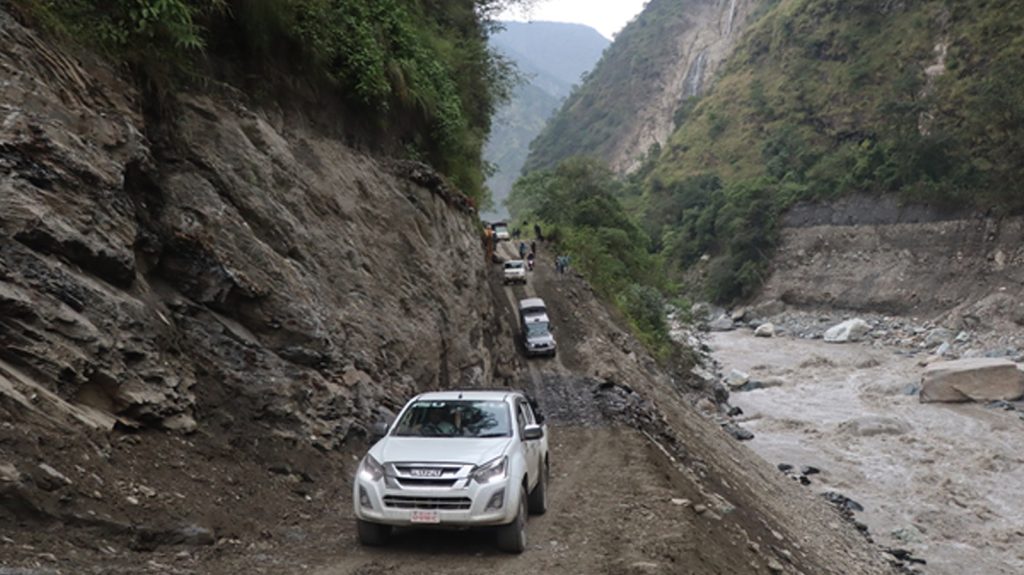
Landslides, subsidence and river erosion damaged the road at around 50 locations, while the Kali Gandaki River washed away sections at 10 sites. Repair work is now in its final stage.
On Thursday evening, emergency vehicles were able to cross the repaired sections at Kunaunta cliff in Raghuganga Rural Municipality-2 and the approach road to the bridge at Pokharebagar in Annapurna Rural Municipality. Both locations had posed major challenges because of damage caused by the Kali Gandaki floods.
Tejaswi Sharma, chief of the Beni-Jomsom-Korala Road Project, said the road currently allows one-way passage only for vehicles carrying fuel, ambulances, equipment needed to restore road, electricity and communication services, and relief supplies.
“Initial repairs have been completed, but landslide debris still needs to be cleared, damaged and eroded sections filled, road levels adjusted and crossings constructed,” Sharma said. “Since traffic at the moment would be chaotic and pose accident risks, we plan to complete repairs by Sunday and resume traffic from Monday.”
Rs 900 million in damage, Rs 3 billion needed for reconstruction
The damage has been particularly severe along the Myagdi section, where more than 20 kilometres of the 33-kilometre stretch have been badly damaged. The section had recently been blacktopped, while concrete paving was underway in landslide-affected areas.
Narendra Subedi, chief of the Federal Road Supervision Office in Pokhara and a former head of the Beni-Jomsom-Korala road project, said the latest floods had caused the most extensive damage since the project began.
He estimated the damage at around Rs 900 million and said an additional Rs 3 billion would be required to rebuild the road under a new design.
Subedi attributed the scale of destruction to heavy rainfall, damaged feeder roads, muck dumped along the riverbanks by hydropower projects, weak geological conditions, newly formed landslides and rising flood levels in tributaries of the Kali Gandaki River.
Although the government has prioritised reopening the route within two weeks because of its importance for trade with China, restoring it to its previous condition will require substantial investment and infrastructure work, he said.
More than 500 containers stranded
The road’s reopening is particularly important ahead of Dashain and Tihar, with more than 500 containers carrying goods imported through the Korala border crossing for the Dashain season stranded at various locations in Mustang and Myagdi.
Authorities are also preparing for increased traffic linked to cargo transport, exports of Mustang apples and potatoes, and the peak tourist season.
Myagdi Chief District Officer Ganesh Gaire said officials, including security personnel and elected representatives, inspected the road on Thursday to plan traffic management.
“We have discussed prioritising essential services, freight vehicles, local traffic and tourist vehicles. Security personnel may also be deployed at narrow and dangerous stretches to prevent traffic congestion,” Gaire said.
He urged tourists planning leisure trips to Mustang to postpone their visits for a few days until road conditions improve, given the need to prioritise essential supplies, local travel and vehicles transporting apples and potatoes to market.
A joint meeting of the security committees of Myagdi and Mustang was scheduled for Friday morning to finalise plans for managing traffic once the road reopens.