BYD Overtakes Tesla and Becomes World’s Largest Electric Vehicle Seller
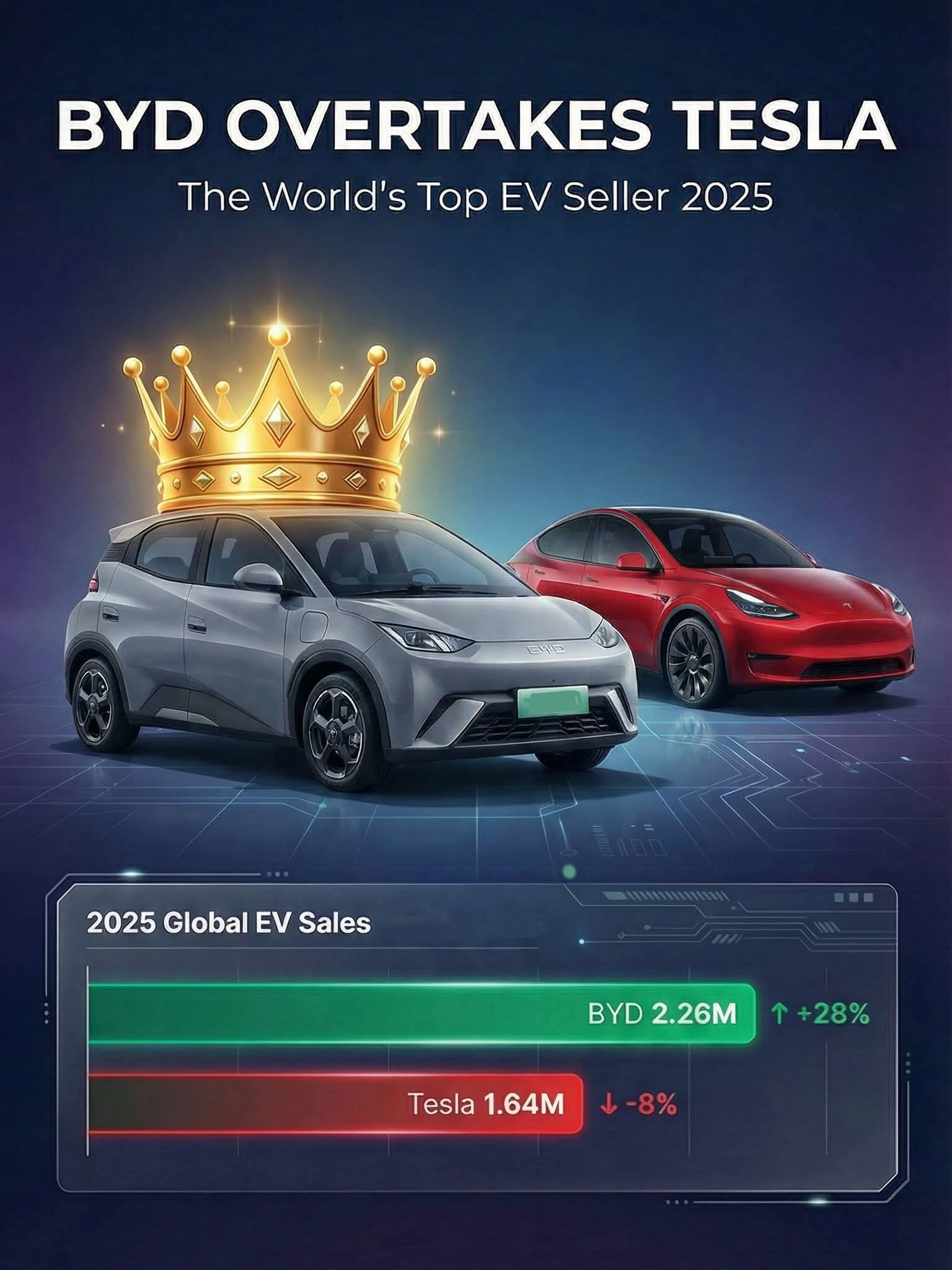
China’s BYD has surpassed Elon Musk-led Tesla to become the world’s largest seller of electric vehicles, marking a significant shift in the global EV industry as Chinese manufacturers continue to gain ground against established Western brands.
BYD announced that its sales of battery-powered electric vehicles rose by nearly 28 percent in 2025 to more than 2.25 million units worldwide. In contrast, Tesla reported global sales of 1.64 million vehicles for the year, representing a decline of almost 9 percent. This marks Tesla’s second consecutive year of falling car deliveries and the first time it has been overtaken by its Chinese rival on an annual basis.
The gap widened toward the end of the year, with Tesla’s car sales falling 16 percent in the final quarter of 2025. Analysts attribute part of the decline to the repeal of a key government subsidy in the United States, which had reduced the purchase price of certain electric and hybrid vehicles by as much as $7,500. The loss of this incentive dampened demand at a time when competition in the EV market is intensifying.
Tesla has also faced a challenging year amid mixed consumer responses to new models, growing unease among some investors over Musk’s political activities, and mounting pressure from lower-priced Chinese electric vehicles. Companies such as BYD, Geely and MG have aggressively undercut Western rivals, reshaping price expectations in key markets.
In response to slowing demand, Tesla launched lower-priced versions of its two best-selling models in the US in October, aiming to regain momentum. However, Wall Street analysts have since revised down their sales forecasts for Tesla in 2026, signalling concerns about the company’s near-term growth prospects.
While BYD has taken the lead in unit sales, Tesla has remained more profitable in recent quarters, supported by higher margins and revenue from software-related services. Despite this, BYD’s rapid global expansion has strengthened its position as a dominant force in the EV sector. The Shenzhen-based automaker has seen particularly strong growth in Latin America, Southeast Asia and parts of Europe, even as several countries impose steep tariffs on Chinese-made electric vehicles.
In October, BYD said the United Kingdom had become its largest market outside China, reporting an 880 percent surge in sales in Britain in the year to the end of September. The growth was driven largely by demand for the plug-in hybrid version of its Seal U sports utility vehicle.
Looking ahead, Tesla’s strategy increasingly hinges on future technologies rather than vehicle sales alone. As part of a shareholder-approved compensation deal, Musk is required to significantly boost Tesla’s long-term valuation and deliver ambitious projects, including the rollout of self-driving robotaxis and the sale of one million humanoid robots over the next decade. The company has invested heavily in its Optimus robot and autonomous driving systems, with analysts viewing the planned 2026 self-driving rollout as critical to Tesla’s future performance.
Despite scepticism around Tesla’s self-driving ambitions, some analysts remain optimistic. Dan Ives of Wedbush Securities has said Tesla could command around 70 percent of the self-driving market over the next decade, citing the company’s scale and technological depth.
BYD’s ascent, however, underscores a broader trend in the global auto industry, where Chinese manufacturers are no longer just competing on cost but are increasingly shaping the direction of the electric vehicle market worldwide.