High School Satellite Project “MUNAL”: Empowering Students and Advancing Nepal’s Space Program

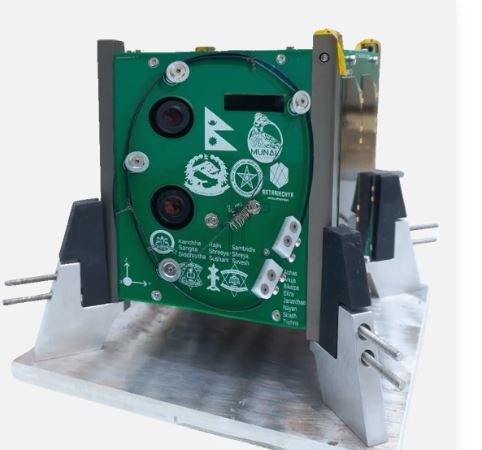
In an unprecedented educational and technological initiative, the Nepal Academy of Science and Technology (NAST), in collaboration with Antarikhchya Pratisthan Nepal (APN), has launched the High School Satellite Project, named Project MUNAL. The program is designed to enable high school students to design, build, test, and launch Nepal’s second CubeSat, marking a major milestone in youth-driven space research in the country.
Project Overview
Project MUNAL is part of the High School Consortium Project, aiming to provide hands-on experience in satellite engineering, space systems design, and mission execution for high school students. The project is being developed by a core team of nine high school students, guided and mentored by a team of experts in the field.
The satellite has been developed over a two-year period with active participation from students of:
- Kathmandu University High School (KUHS)
- Chaitanya Secondary School
- Azad Secondary School
- Sanjiwani Model Higher Secondary School
The CubeSat has been constructed at the Space Systems Laboratory (SSL), located at KUHS. It is slated for launch in early 2024, contributing to Nepal’s growing presence in space research and technology.
Mission and Objectives
Mission Statement:
Project MUNAL is focused on the in-house design, development, and launch of Nepal’s second CubeSat, entirely driven and managed by high school students, making it a landmark educational space project in the country.
Primary Objectives:
- Conduct the design, build, test, and launch of Nepal’s second CubeSat entirely in-house.
- Demonstrate a novel Satellite System-on-Chip (SSoC)-based communication and on-board computer (COM/OBC) developed by the students.
- Continue and expand on the two missions of NepalSat-1: the Store & Forward (S&F) Mission and the Imaging Mission.
Secondary Objectives:
- Build a vegetation density database of the Earth’s surface.
- Implement image segmentation for landmass identification using Artificial Intelligence (Machine Learning), enhancing the efficiency of high-quality image downlink.
Missions Incorporated in MUNAL
To achieve its objectives, Project MUNAL integrates the following missions:
- Camera Mission – The satellite is equipped with imaging sensors to capture high-resolution photographs of Earth, supporting environmental monitoring, urban planning, and resource management.
- Passive Altitude Control and Determination Mission – This mission ensures that the satellite maintains a stable orbit, enabling consistent data acquisition and mission reliability.
- Satellite System-on-Chip (SSoC) Payload Demonstration Mission – MUNAL will serve as a testbed for in-house developed SSoC, providing hands-on experience in communication and on-board computing systems.
- Art Mission – A unique initiative that incorporates creativity and visual design into satellite missions, engaging students in educational and outreach components alongside technical objectives.
Educational Impact
The High School Satellite Project is intended to empower young Nepalese students by providing real-world experience in advanced technologies. Students are gaining knowledge in:
- Satellite design and engineering
- Electronics and embedded systems
- Artificial intelligence and image processing
- Project management and teamwork
The initiative not only builds technical proficiency but also encourages innovation, scientific inquiry, and leadership among high school students.
Significance for Nepal
Project MUNAL is the second high school-driven CubeSat from Nepal, following NepalSat-1, and represents a strategic step in the country’s space technology development. By enabling students to lead the design and operational aspects of a satellite, Nepal is fostering a pipeline of future scientists, engineers, and space professionals.
Through MUNAL, students are positioned at the intersection of education, technology, and space research, providing a model for youth-led scientific projects in developing countries. The satellite’s missions, particularly in Earth observation and AI-based imaging, are expected to contribute valuable data for environmental monitoring, urban planning, and research in Nepal and globally.
Conclusion
Project MUNAL demonstrates how collaboration between educational institutions and scientific organizations can bridge the gap between classroom learning and practical space technology applications. As the satellite nears its planned launch in early 2024, students, mentors, and institutions involved are preparing to showcase Nepal’s capability in space engineering on an international stage.
This project is a testament to student innovation, national scientific ambition, and the potential of youth to advance Nepal’s technological frontiers, and it sets the stage for future educational satellite projects in the country.
Related Stories