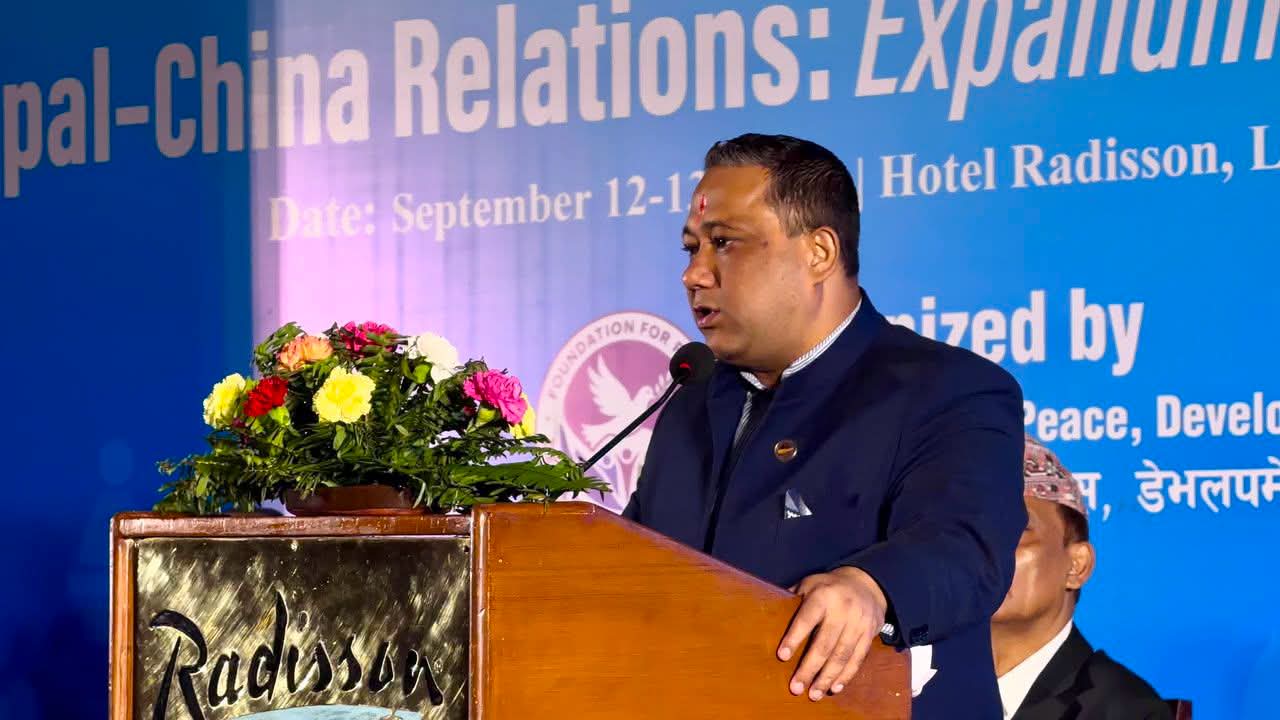
Kathmandu – Foreign Minister Shishir Khanal has said Nepal and China should expand their relationship beyond conventional border management and develop a strategic partnership focused on environmental cooperation, climate security, technology, trade and infrastructure.
Addressing the third Kasthamandap Dialogue in Kathmandu on Saturday, Khanal said the recent Bhotekoshi flood demonstrated that the Nepal–China border is not merely a political boundary but also an area connected by a shared ecological destiny.
The programme was organised under the theme “Nepal–China Relations: Expanding Dimensions of Cooperation.”
Khanal described the devastating August 26 flood as a “Himalayan tsunami” and expressed condolences to those who lost their lives. He also thanked the Chinese government for providing emergency relief, technical assistance and hydrological coordination during the crucial rescue period.
“Geography does not merely draw a political border between Nepal and China; it connects our shared destiny,” he said.
Himalayas are a shared ecological heritage
Khanal said the Himalayas should no longer be viewed as a barrier separating the two countries. Instead, they should be recognised as a shared ecological heritage that requires collective protection.
With climate change and environmental risks increasing, he said ecological resilience and climate security should become central pillars of Nepal–China cooperation.
He proposed real-time satellite data sharing, joint weather forecasting and improved early-warning systems to reduce the risks posed by cross-border disasters, including glacial lake outburst floods, irregular weather patterns and landslides.
“We must recognise the Himalayas not as a barrier that separates us, but as a shared sanctuary requiring collective protection,” Khanal said.
Nepal reaffirms commitment to One China policy
Referring to the centuries-old civilisational exchanges between Nepal and China, Khanal said bilateral relations have been guided by the Five Principles of Peaceful Coexistence, sovereign equality, mutual trust and non-interference since diplomatic relations were established in 1955.
He reaffirmed Nepal’s firm commitment to the One China policy and said Nepali territory would not be allowed to be used for activities against its neighbours.
Khanal also praised China for respecting Nepal’s sovereignty, independence and territorial integrity. He said the Nepal–China strategic partnership established in 2019 reflects the depth of mutual respect and cooperation between the two countries.
He added that Nepal’s foreign policy is guided by the philosophy of the “middle path” and that the country wants to develop itself as an active, confident and sovereign bridge between two major economic powers.
Greater connectivity and resilient infrastructure needed
Khanal said the government formed following the March 5, 2026 general election has prioritised good governance, the elimination of systemic weaknesses, social justice and broad-based prosperity.
Nepal’s foreign policy should support the country’s economic prosperity, he said, adding that the government is advancing the concept of “thick connectivity and thin borders” through its economic diplomacy.
He stressed that better infrastructure and disaster resilience at northern border points would be essential for turning the Trans-Himalayan Multi-Dimensional Connectivity Network into reality.
According to Khanal, customs infrastructure should be modernised, high-altitude border ports should be developed into year-round commercial centres, and roads, bridges and cross-border infrastructure should be rebuilt to withstand floods, landslides and other environmental threats.
Nepal can learn from China’s technological development
The foreign minister said Nepal could learn from China’s achievements in poverty reduction, rural revitalisation and agricultural modernisation.
He also noted that China has emerged as a global leader in green technology, robotics and generative artificial intelligence.
Recalling his visit to China in June, Khanal said he observed the country’s technological and scientific capabilities firsthand. He referred to cooperation between Nepali and Chinese hydrologists at the Chinese Academy of Sciences’ Institute of Tibetan Plateau Research, where they are studying glaciers and glacial lakes in high-altitude regions.
“Rigorous scientific research does not recognise national boundaries,” he said.
Khanal proposed establishing joint innovation laboratories, institutional incubation centres and structured technology-transfer programmes to connect Nepal’s young workforce with emerging technologies.
Such cooperation could help develop AI-powered agricultural systems suitable for mountain economies, digitalise public services and strengthen disaster-risk reduction mechanisms, he said.
People-to-people ties are the foundation of Nepal–China relations
Khanal said the long-term foundation of Nepal–China relations lies in the relationship between the people of the two countries.
He called for greater exchanges among students, scholars, entrepreneurs, tourists and pilgrims. He also stressed the need to provide Nepali students, researchers and young entrepreneurs with more opportunities to learn about Chinese industries, governance and technology.
Similarly, he said Chinese researchers, academics and tourists should be given more opportunities to explore Nepal’s rich culture, linguistic diversity and spiritual traditions.
Disaster has not weakened Nepal’s determination
Khanal said the August 26 disaster was a serious test for Nepal but had not weakened the country’s determination.
He reaffirmed Nepal’s commitment to restoring damaged routes, strengthening vulnerable mountainous areas and building more resilient communities.
The foreign minister said cooperation between Nepal and China in environmental protection, science, infrastructure and disaster preparedness would be crucial for protecting communities on both sides of the Himalayas.