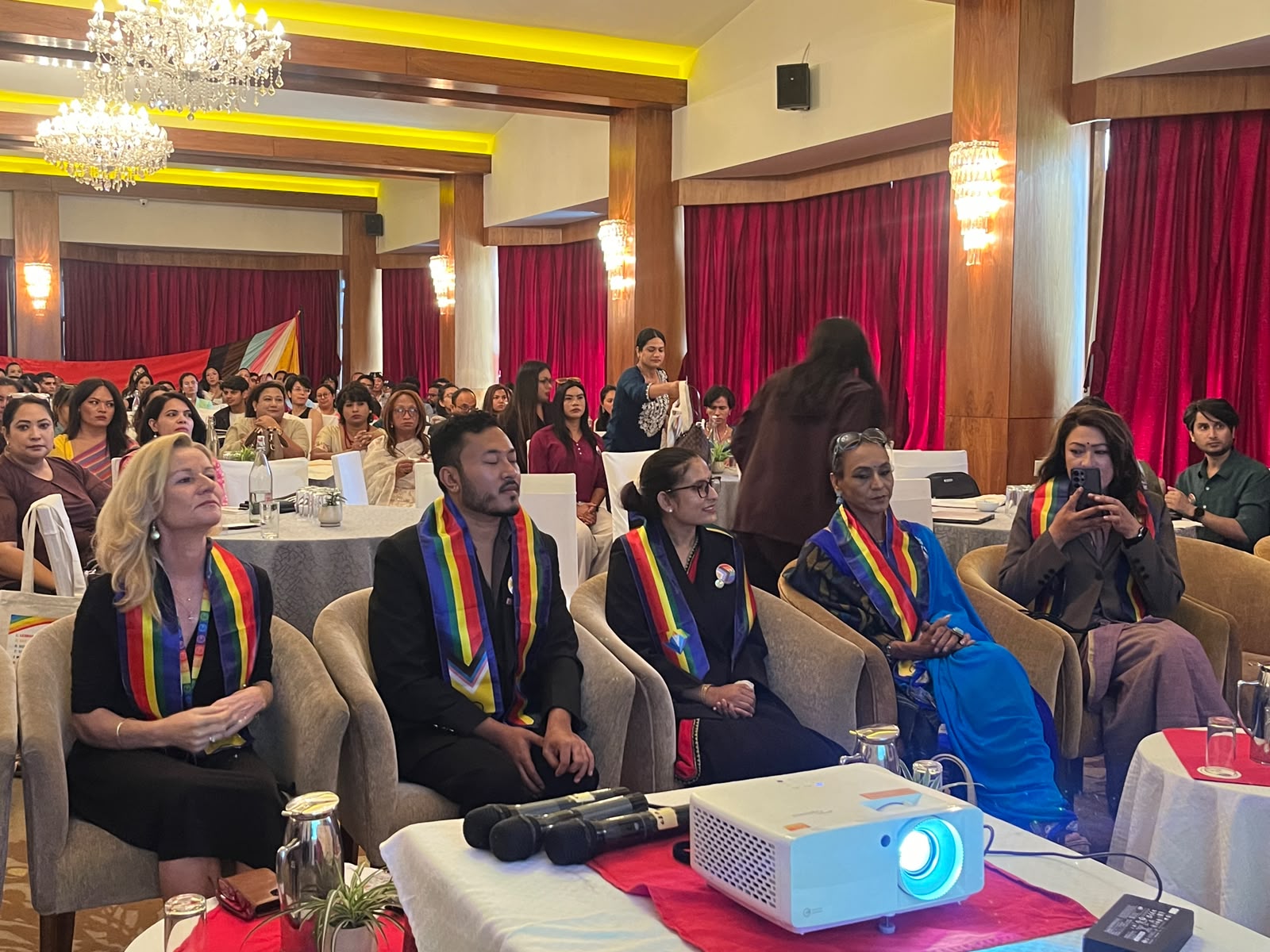
Kathmandu- With rainbow flags, music and heartfelt speeches, members of Nepal’s LGBTQIA+ community gathered in Kathmandu to celebrate Pride Month. But beyond the celebrations, the event carried a powerful message: legal recognition alone is not enough. Equality must also be lived, felt and experienced in everyday life.
Observed globally throughout June, Pride Month commemorates the struggles, resilience and achievements of lesbian, gay, bisexual, transgender, queer, intersex and other sexual and gender minority communities. It is a time to honor those who fought for visibility and rights, while continuing the push for a more inclusive future.At a special Pride Month celebration organized by Blue Diamond Society, activists, lawmakers, artists and community members reflected on both Nepal’s remarkable progress and the challenges that remain.
Nepal is widely recognized as one of the most progressive countries in Asia when it comes to LGBTQIA+ rights. Unlike many neighboring countries, Nepal has taken significant constitutional, judicial and policy-level steps to recognize and protect sexual and gender minorities.
Same-sex relationships are legal. The Constitution guarantees equality and protection from discrimination. Nepal was among the first countries in the world to legally recognize a third gender on official documents. Supreme Court rulings have directed the government to end discriminatory laws and ensure equal protection for LGBTQIA+ citizens. More recently, court decisions have opened pathways for the registration of same-sex marriages.The country’s political journey has also been historic. Nepal made global headlines when it elected one of the world’s first openly gay lawmakers. Today, the election of transgender woman lawmaker Bhumika Shrestha represents another milestone in the country’s evolving commitment to inclusion and representation.Yet speakers at the event repeatedly stressed that progress on paper does not always translate into progress in people’s daily lives.
““Having laws is important, but implementation remains weak,” said LGBTQIA+ activist Kanak Panthi. While Nepal’s legal framework is often praised internationally, they noted that many sexual and gender minorities continue to face barriers in employment, public services and social acceptance.” said LGBTQIA+ activist Kanak Panthi . While Nepal’s legal framework is often praised internationally, they noted that many sexual and gender minorities continue to face barriers in employment, public services and social acceptance.Those concerns echoed throughout the gathering.Addressing the audience, Nepal’s first transgender Member of Parliament, Bhumika Shrestha, described her election as both a personal achievement and a collective victory for a community that has long struggled for recognition. She said she now occupies a space where policies and decisions are made, but meaningful change will require continued support from society, institutions and political leaders. Shrestha emphasized that while she remains committed to advocating for sexual and gender minority rights, her responsibility as a lawmaker extends to all Nepalis.Minister Dita Badi also expressed solidarity with LGBTQIA+ communities, pledging to stand alongside sexual and gender minorities in their pursuit of equality, dignity and justice. She said inclusion should not be viewed as a privilege granted to a few but as a fundamental right guaranteed to every citizen.
Similarly, lawmaker and Chairperson of the Parliamentary Committee on Law, Justice and Human Rights, Samikshya Baskota, acknowledged that many people still lack a basic understanding of issues affecting sexual and gender minorities.She called for greater public education and awareness, saying that social acceptance can only grow when people are willing to listen, learn and understand experiences different from their own.For artist and activist Sunidha Tuladhar, Pride is not something that should be celebrated only once a year.
“Pride should be celebrated every day,” she said, arguing that many members of sexual and gender minority communities still struggle to find employment, secure equal opportunities and live openly without fear of discrimination.
According to Tuladhar, Pride is about more than identity. It is about having the freedom to be oneself, to love openly, to take pride in who you are and to contribute to building a more compassionate and inclusive society.
“Being yourself should never be a barrier to employment, education or dignity,” she said.
Actor and community advocate Pooja Thing Lama echoed similar sentiments, describing diversity as one of society’s greatest strengths.
“We are all beautiful flowers in the same garden,” she said. “We must respect one another and allow everyone to live with dignity.”
For Lama, Pride Month is also about remembering those who came before — the activists, advocates and community members whose sacrifices made today’s progress possible.
She said June serves as an opportunity to reflect on the importance of unity, collective struggle and community solidarity, values that remain essential as the movement continues pushing for greater equality.Throughout the program, participants shared stories of perseverance, rejection, acceptance and hope. Some spoke of supportive families and communities. Others described discrimination they still encounter in workplaces, schools and public spaces.Their experiences underscored a recurring theme of the event: Nepal’s laws may be among the most progressive in the region, but social acceptance often moves more slowly than legal reform.
In urban centers such as Kathmandu and Pokhara, LGBTQIA+ visibility has increased significantly over the past decade. Pride events, advocacy campaigns and community organizations have helped normalize conversations around gender identity and sexual orientation.Yet outside major cities, many sexual and gender minorities continue to face stigma, misunderstanding and exclusion.Advocates say the next phase of Nepal’s LGBTQIA+ movement must focus not only on legal victories but also on implementation, awareness and economic opportunity.Equal access to jobs, healthcare, education and public services remains a pressing concern. Many transgender individuals, in particular, continue to face barriers that make it difficult to secure stable employment and financial security.
As the event drew to a close, speakers returned to the symbolism of the rainbow itself.Just as different colors come together to create something beautiful, they said, societies become stronger when they embrace diversity rather than fear it.The celebration ended not simply as a festival, but as a reminder that Pride is both a recognition of how far Nepal has come and a call to continue moving forward.For many gathered in Kathmandu, that journey is ultimately about something simple yet profound: creating a country where every person, regardless of gender identity or sexual orientation, can live openly, safely and with dignity.
And while Nepal’s rainbow may already shine brighter than many in the region, participants agreed that the work of ensuring equality for all is far from complete.