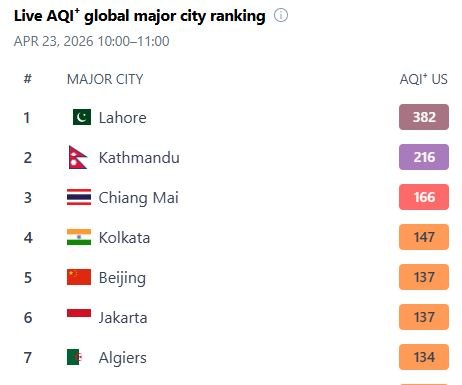
Kathmandu-Kathmandu is once again struggling under severe air pollution as the Air Quality Index (AQI) reached 216 at around 11:00 AM, placing the valley in the “very unhealthy” category. The capital has also been ranked second among the world’s most polluted cities, reflecting a deepening environmental crisis. According to global standards, AQI levels between 201 and 300 are considered very unhealthy, meaning the entire population is now exposed to serious health risks.
Health experts warn that this level of pollution is extremely dangerous because fine particulate matter (PM2.5) can enter deep into the lungs and bloodstream. Doctors report a rise in cases of eye irritation, dry cough, throat discomfort, breathing difficulties, headaches, and fatigue, particularly among children and elderly people. “Prolonged exposure can lead to chronic respiratory and cardiovascular diseases,” said a senior doctor at a Kathmandu-based hospital, noting a steady increase in pollution-related patients.
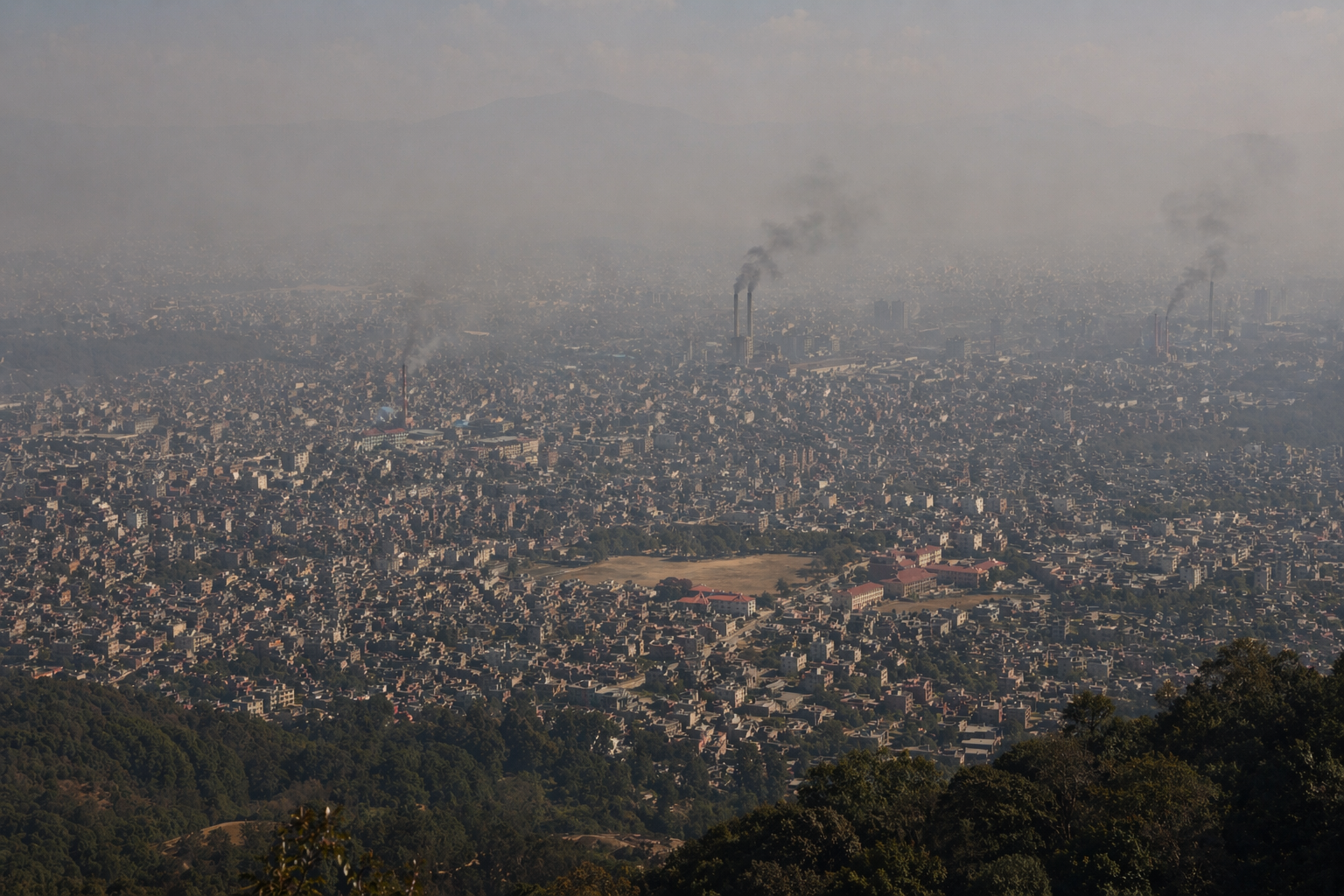
The impact is clearly visible in daily life across the valley. Thick smog has reduced visibility, with surrounding hills appearing faded even during daylight. Outdoor activities such as walking, commuting, and school sports have been heavily affected. Resident Samir Karki said, “I have had eye burning, dry cough, and headache for the past few days. It gets worse when I stay outside for long.”
Similarly, Krishna Gurung shared his ongoing discomfort, saying, “My eyes have been burning for more than three days. It feels better after washing, but it comes back when I go outside.” Another resident, Sarita Limbu, said dust exposure has made daily walking difficult. “I feel a burning sensation in my nose whenever I walk outside,” she said.
Experts say multiple factors are responsible for the worsening air quality, including vehicle emissions, dust from construction sites, industrial pollution from brick kilns, open waste burning, and forest fires in surrounding regions. Environmentalist Barsha Parajuli said, “We are facing multiple pollution sources at the same time. People should minimize exposure, and stronger control measures are urgently needed.”
Kathmandu’s bowl-shaped geography further traps pollutants, making the situation worse during dry seasons. Experts stress that this is no longer a seasonal issue but a structural public health emergency requiring long-term action.
To address the crisis, specialists recommend strict vehicle emission testing, expansion of electric public transport, and stronger regulation of industrial emissions. They also call for a complete ban on open waste burning, improved dust control at construction sites, and strengthened air quality monitoring systems.
As AQI levels remain in the very unhealthy range, authorities are urging residents to limit outdoor exposure and use protective masks. However, experts emphasize that individual precautions alone are not enough, and sustained policy action is urgently needed to prevent further deterioration of Kathmandu’s air quality.