
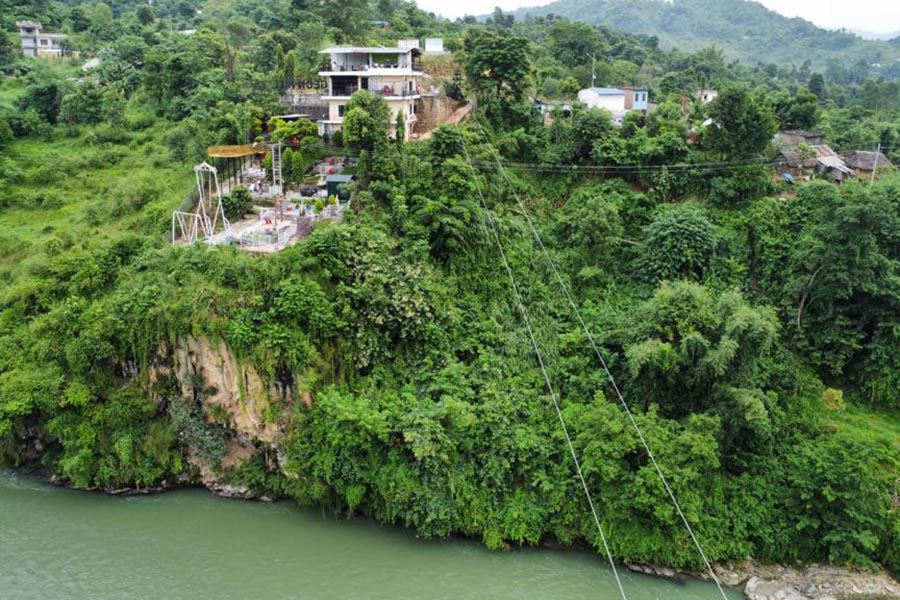
Kathmandu – The government has introduced a new policy allowing adventure tourism activities and the construction of four-star and higher-rated hotels in designated leasehold forest areas through an ordinance amending existing forest laws.
President Ram Chandra Paudel has issued the Ordinance to Amend Some Nepal Acts Relating to Forests, 2083 BS, expanding the permitted uses of leasehold forests for tourism-related infrastructure development.
Previously, the Forests Act, 2019, allowed leasehold forests to be used for activities such as producing raw materials for forest-based industries, agroforestry, livestock farming and ecotourism, provided they supported forest conservation and development. The new amendment broadens the scope of ecotourism and allows additional tourism infrastructure under specified conditions.
Under the revised provisions, the Council of Ministers may lease part of a national forest for nature-based ecotourism, provided the activities do not adversely affect the environment. Permitted adventure activities include paragliding, skydiving, bungee jumping, zip-lining, rock climbing, rafting and canoeing. Cable cars, chairlifts, ropeways and gravity-flow systems may also be constructed, alongside hotels rated four stars or above.
Other infrastructure for nature-based ecotourism may be developed if it is specified by the Government of Nepal through a notice published in the Nepal Gazette.
The ordinance sets limits on the area that can be used for construction. Infrastructure development must remain within the leased forest area and cannot exceed 20 percent of the total forest area covered by the lease agreement or 2.5 hectares, whichever is smaller. The remaining land must be used for forest conservation, development and restoration.
Developers will also be required to pay an environmental protection fee into a designated fund based on the forest area used for infrastructure. An environmental study report is mandatory for projects, while tree felling within designated areas requires a recommendation from the relevant office and approval from the central department.
The amendment does not permit similar infrastructure development in national parks or other ecologically sensitive forest areas. The government may also revoke lease agreements if developers violate forest and environmental laws, disregard environmental study reports or breach contractual conditions.
The government has been considering opening forest areas to tourism activities for years. The new ordinance establishes a legal framework for such development while retaining requirements for environmental protection and forest restoration.
Photo source – online khabar