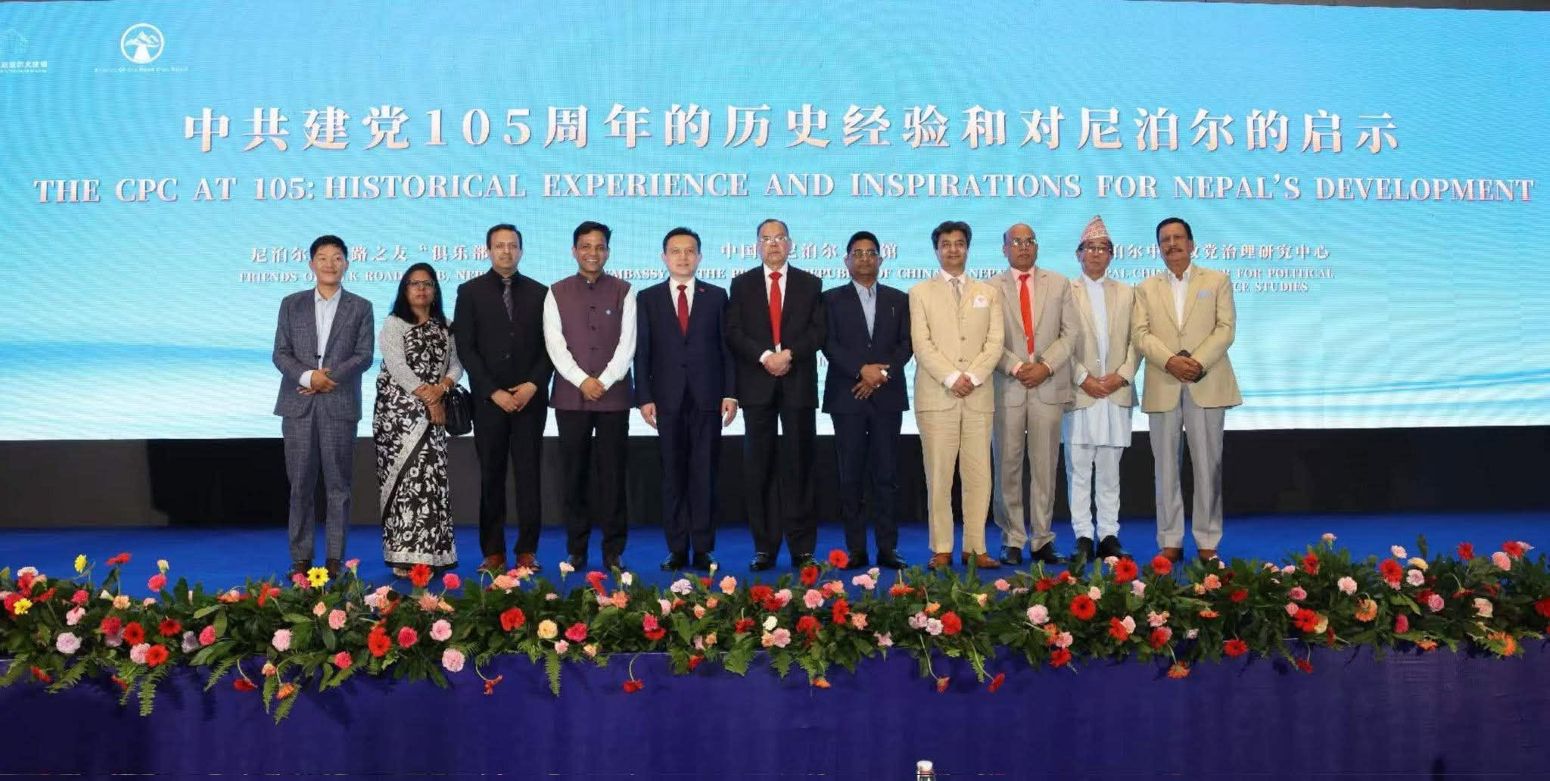
Kathmandu – A high-level interaction marking the 105th anniversary of the Communist Party of China (CPC) was held in Kathmandu, where Chinese Ambassador Zhang Maoming and senior Nepali political leaders highlighted the importance of strengthening Nepal–China relations, expanding economic cooperation, and advancing regional connectivity frameworks.
The program was organized by the Embassy of the People’s Republic of China in Nepal, in collaboration with the Friends of Silk Road Club Nepal and the Nepal-China Center for Political Party Government Studies.
Addressing the event, Dr. Kalyan Sharma, General Secretary of the Friends of Silk Road Club Nepal and one of the organizers, stated that the interaction served as an important platform to deepen mutual understanding between Nepal and China at the political, institutional, and people-to-people levels.
He emphasized that such engagements help strengthen strategic dialogue, policy learning, and development cooperation between the two countries. According to him, the participation of leaders from multiple political parties reflects Nepal’s consistent commitment to balanced diplomacy and constructive engagement with its northern neighbor.
Sharma further noted that initiatives like the Belt and Road Initiative (BRI) and other global frameworks proposed by China provide opportunities for infrastructure development, connectivity enhancement, and long-term economic transformation in Nepal. He stressed that Nepal should actively engage in such platforms while safeguarding national interests.
Chinese Ambassador’s Four-Point Proposal
Addressing the seminar, Ambassador Zhang Maoming presented a four-point proposal aimed at deepening bilateral ties between Nepal and China.
He emphasized enhanced cooperation between political parties of both countries, particularly in sharing experiences on poverty alleviation, governance, economic development, and party-building practices. According to him, such exchanges would help strengthen institutional learning and political understanding.
The ambassador also stressed aligning Nepal’s development strategy with China’s Belt and Road Initiative (BRI), particularly by accelerating the development of the Trans-Himalayan Multi-Dimensional Connectivity Network, which aims to improve cross-border infrastructure and regional connectivity.
In addition, he highlighted cooperation under global initiatives proposed by Chinese President Xi Jinping, including the Global Development Initiative (GDI), Global Security Initiative (GSI), Global Civilization Initiative (GCI), and Global Governance Initiative (GGI), calling for joint implementation with Nepali partners in international forums such as the United Nations and the Shanghai Cooperation Organization.
The fourth proposal focused on people-to-people ties, especially youth and cultural exchanges, which he said are essential for ensuring the long-term sustainability of Nepal–China friendship across generations.
Ambassador Zhang also noted CPC’s historical evolution from a small organization to the world’s largest ruling party with over 100 million members, highlighting its governance model, poverty reduction achievements, and strict internal discipline. He stated that China has investigated millions of corruption cases and taken disciplinary action against hundreds of thousands of individuals as part of its anti-corruption drive.
Nepali Leaders Highlight Development Cooperation
Former Prime Minister and senior CPN (Unified Socialist) leader Jhalanath Khanal praised the CPC’s ideological clarity, governance discipline, and development achievements. He said China’s model of “socialism with Chinese characteristics” offers an alternative development pathway for developing countries.
Khanal stressed that Nepal should design its own development model based on its geography, culture, and national realities rather than copying foreign systems. He also emphasized strengthening the implementation of BRI projects and advancing the Trans-Himalayan connectivity framework.
Reaffirming Nepal’s foreign policy stance, he reiterated commitment to the “One China Policy” and emphasized that Nepali territory would not be allowed to be used against any neighboring country.
Rastriya Swatantra Party (RSP) General Secretary Binay Acharya described China’s transformation from poverty to prosperity as an inspiring example of national governance. He noted that Nepal–China relations go beyond geography and are historically rooted in cultural ties dating back to the era of Araniko. He expressed optimism about deeper cooperation between RSP and the CPC in areas such as technology, infrastructure, and biotechnology.
Rastriya Prajatantra Party (RPP) parliamentary leader Gyanendra Shahi argued that Nepal should avoid blindly copying foreign development models. He emphasized the need for a homegrown development approach based on Nepal’s national interests, geography, and economic realities. He also highlighted youth migration as a major challenge, calling for stronger domestic job creation through industrial development, agricultural modernization, and renewable energy expansion.
He further suggested that Nepal should focus on technology transfer rather than relying solely on aid or loans.
Nepali Congress leader Udaya Shamsher Rana reiterated his party’s strong commitment to the One China Policy, noting that modern Nepal–China relations were historically shaped during the leadership of B.P. Koirala. He called for continued cooperation between the two countries.
CPN-UML leader Raghuvir Mahaseth and Janamat Party leader Jay Kant Raut also praised China’s governance and development achievements, describing them as valuable learning models for Nepal. They emphasized the importance of strengthening bilateral friendship and cooperation.
Shared Vision for Economic Partnership
Speakers across political parties collectively underscored the need for stronger Nepal–China economic cooperation, greater connectivity through BRI projects, and enhanced regional stability through mutual trust and respect.
While acknowledging differing political ideologies, leaders agreed that both countries share common interests in development, prosperity, and regional peace. The event concluded with a shared commitment to deepen bilateral ties and expand practical cooperation in the years ahead.