
Khandbari — Nepal has officially handed over the newly completed Chyamtang–Ghonghoppa road section in Sankhuwasabha, a strategically important part of the Khandbari–Kimathanka highway that connects Nepal with China and India through the eastern Himalayan region. The road, constructed by the Nepali Army under extremely difficult geographical and weather conditions, has now been transferred to the North–South (Koshi) Road Project.
The 10.81-kilometre road section lies in the remote Bhotkhola rural municipality and is considered a major component of the Kimathanka–Biratnagar corridor, one of Nepal’s shortest routes linking the two neighbouring countries. According to project officials, the Nepali Army had been assigned responsibility for opening the track under the tri-national Kimathanka–Jogbani road network.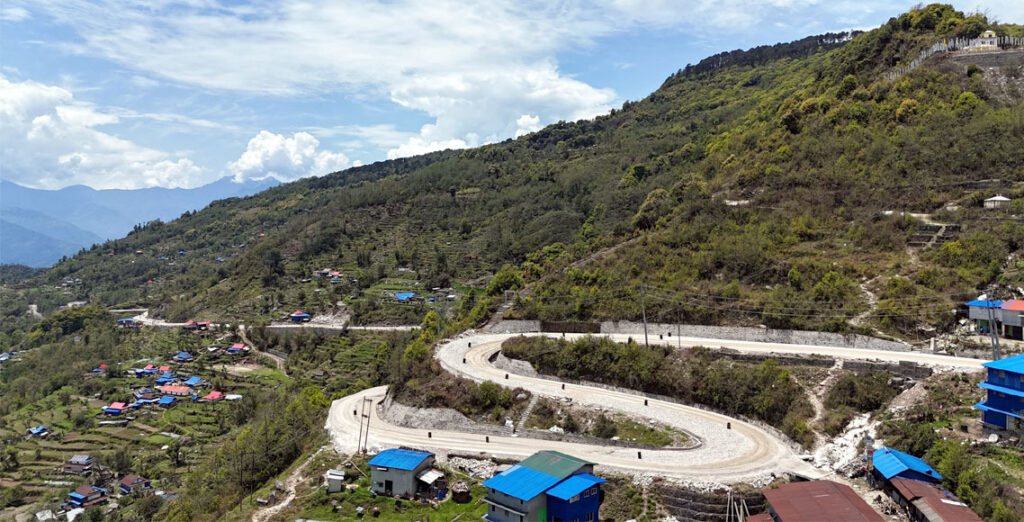
Despite harsh weather, steep rocky terrain, and technical challenges, the army successfully completed the construction by transporting heavy materials through helicopters in several sections. Officials stated that although the original target was to build 14 kilometres of road, alignment changes during construction shortened the final length to 10.81 kilometres, reducing overall travel distance as well.
The road project was completed at a cost of more than Rs. 62 crore. Authorities believe the route will significantly improve transportation, trade, and economic activities in the northern region of Koshi Province while also strengthening connectivity between Nepal, India, and China. Local representatives say the road could eventually play a major role in regional transit and cross-border commerce, benefiting districts including Morang, Sunsari, Dhankuta, Terhathum, Sankhuwasabha, and Bhojpur.
Officials have also stated that further upgrading, bridge construction, and gravel works are still required in several sections before full-scale smooth transportation can begin up to Kimathanka border point. The Kimathanka checkpoint is considered one of Nepal’s lowest-altitude border points connected to China with nearby human settlements, making it strategically important for future trade and connectivity.