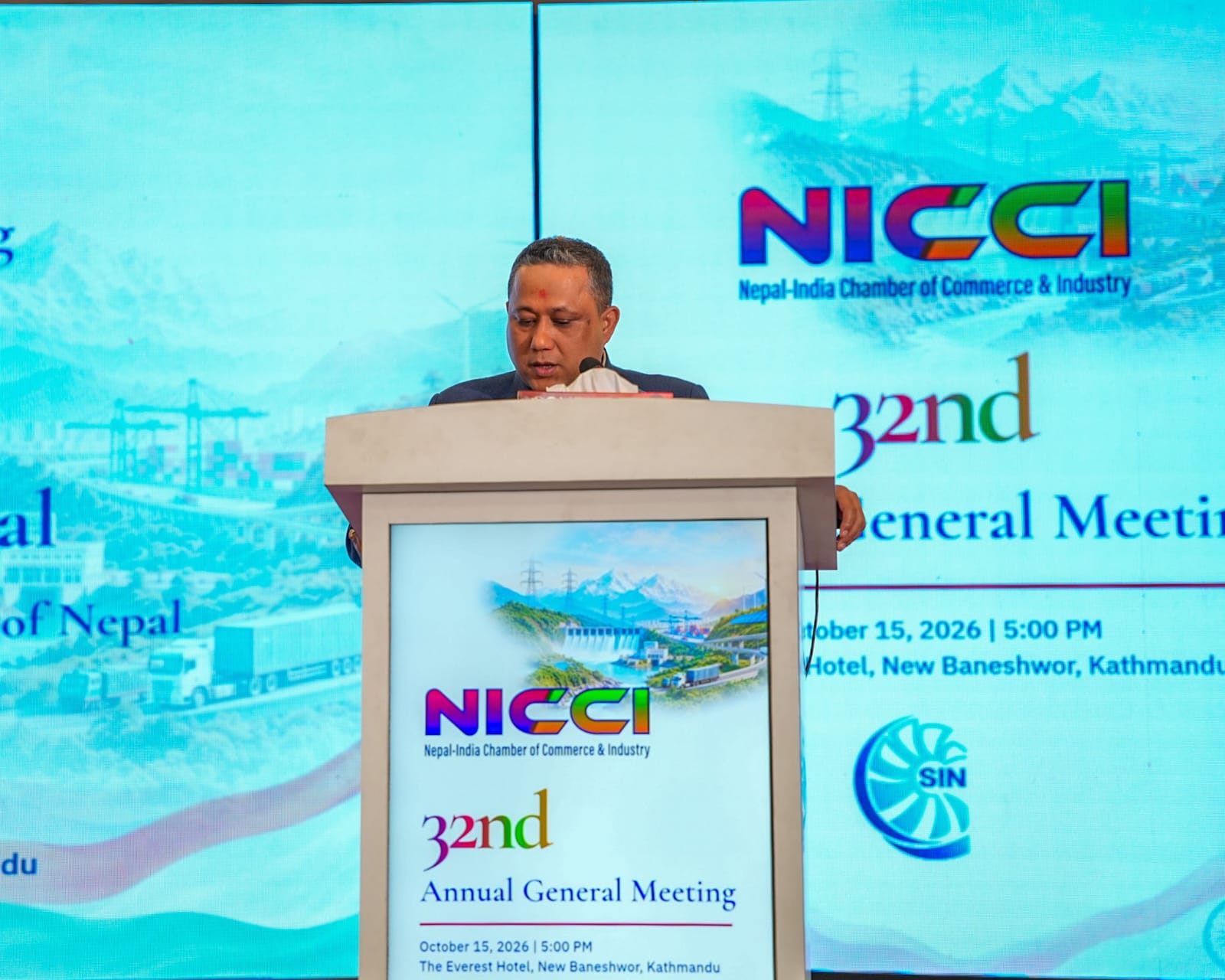
Addressing the 32nd Annual General Meeting of the Nepal-India Chamber of Commerce and Industry (NICCI) in Kathmandu as chief guest, Khanal called for translating the potential of bilateral relations into tangible economic outcomes, emphasizing the need for stronger industrial partnerships, quality investment and technology transfer.
“Diplomacy is no longer confined to the Ministry of Foreign Affairs, formal negotiations and treaties. Industry, trade, energy and digital payment systems have also become important areas of economic diplomacy,” Khanal said.
Highlighting India’s position as Nepal’s largest trading partner and a major source of foreign investment, Khanal said India accounts for more than 60 percent of Nepal’s total external merchandise trade and receives over 80 percent of the country’s merchandise exports.
He urged Indian investors to expand their investments in Nepal, stressing that investment should strengthen domestic production, create employment, facilitate technology and knowledge transfer, and connect Nepali enterprises with regional value chains.
Khanal identified trade facilitation, investment and industrial partnerships, energy cooperation, digital transformation and tourism as key priorities for advancing Nepal-India economic relations.
He underscored the need to connect Nepal’s hydropower potential with India’s expanding energy market through increased investment, transmission infrastructure and regional energy integration.
Cooperation in digital payments, artificial intelligence and financial technology could also help Nepali youth and entrepreneurs benefit from Indian markets, technological advances and emerging business opportunities, he said.
Describing the private sector as a vital partner in economic diplomacy, Khanal said NICCI could play an important role in identifying trade barriers, supporting policy implementation, promoting joint investment and exploring new business opportunities between the two countries.
He also stressed the importance of improving border infrastructure and creating a predictable business environment by reducing customs-related delays, transportation costs and regulatory complexities.
Khanal called for greater participation of small and medium-sized enterprises, women entrepreneurs and young businesspeople in cross-border trade and investment, emphasizing the need to make economic opportunities more inclusive.
“The next chapter of Nepal-India economic relations must connect ambition with effective implementation. Progress in cooperation should be reflected in concrete investment outcomes, the removal of trade barriers, business expansion and technology partnerships,” he said.
Khanal expressed confidence that NICCI, drawing on its 32 years of experience, business networks and institutional credibility, could serve as a strategic partner in strengthening economic relations between Nepal and India.