Private Sector Pledges Support for Nepal’s Economic Revival

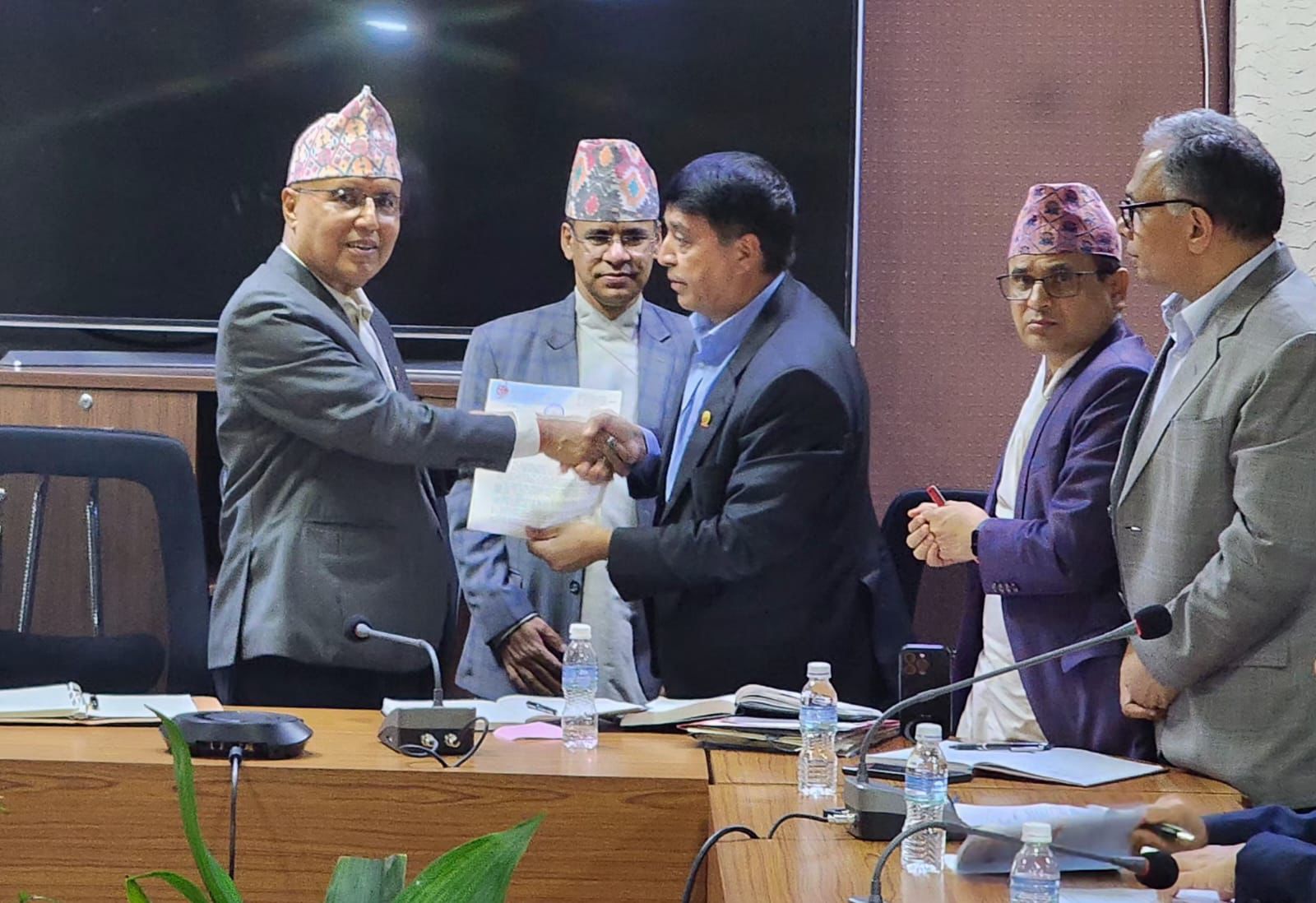
Kathmandu – The private sector has reaffirmed its commitment to cooperate with the government in rebuilding and revitalizing Nepal’s economy. This was conveyed during a discussion with newly appointed Finance Minister Rameshore Khanal at the Ministry of Finance on Tuesday.
Private sector representatives highlighted the need for a collaborative approach to economic reconstruction following recent losses incurred during public unrest. “We have also suffered losses ourselves, but we are ready to rise and support the government in this effort,” said Chandra Dhakal, President of the Federation of Nepalese Chambers of Commerce and Industry (FNCCI).
During the meeting, Dhakal suggested establishing a continuous dialogue mechanism between the government and private sector to restore economic stability and ensure good governance. He also emphasized creating a business-friendly environment that allows entrepreneurs to operate confidently, extending deadlines for tax submissions, and removing fines and penalties.
In response, Minister Khanal approved a ministerial-level decision to extend the tax submission deadline by one month, following FNCCI’s earlier request to extend the deadline until October 11.
Senior Vice President of FNCCI, Anjan Shrestha, proposed that the private sector could also contribute to reconstruction efforts through funds allocated for social responsibility. The representatives stressed the urgency of taking action, noting that Nepal is preparing to graduate from the least developed country (LDC) status in 2026. They warned that delays caused by recent unrest could hinder progress, drawing parallels to Bangladesh, which is postponing its LDC graduation due to trade-related setbacks.
Dhakal further requested the government to offer support such as debt restructuring, investment incentives, and tax concessions to businesses affected by the unrest. He also urged leveraging information technology and promoting ethical governance to meet the expectations of the younger generation seeking efficient public services.
“To stimulate economic activity, it would be beneficial to reduce value-added tax rates, apply lower rates on essential goods, and introduce special packages to attract Indian tourists. Tax relief, production-based support for small and medium enterprises, concessional loans, and budget reallocation for reconstruction are also essential,” Dhakal added.
Other private sector leaders echoed these sentiments. Birendra Pandey, President of the Nepal Industries Federation, stressed boosting business confidence to facilitate economic revival. Kamlesh Kumar Agrawal, President of the Nepal Chamber of Commerce, highlighted the private sector’s significant role in the economy and the need to restore entrepreneurial morale. Karan Chaudhary, President of the NADA Automobile Association, and Min Bahadur Gurung, Managing Director of Bhat-Bhateni Supermarket, also expressed readiness to contribute to reconstruction despite substantial losses.
Minister Khanal assured the private sector that the government’s economic recovery efforts would continue with their support. He confirmed the extension of the tax submission deadline by one month and acknowledged requests for financial relief, including at least a two-year deferment on working capital loans and other immediate financial incentives.
Related Stories