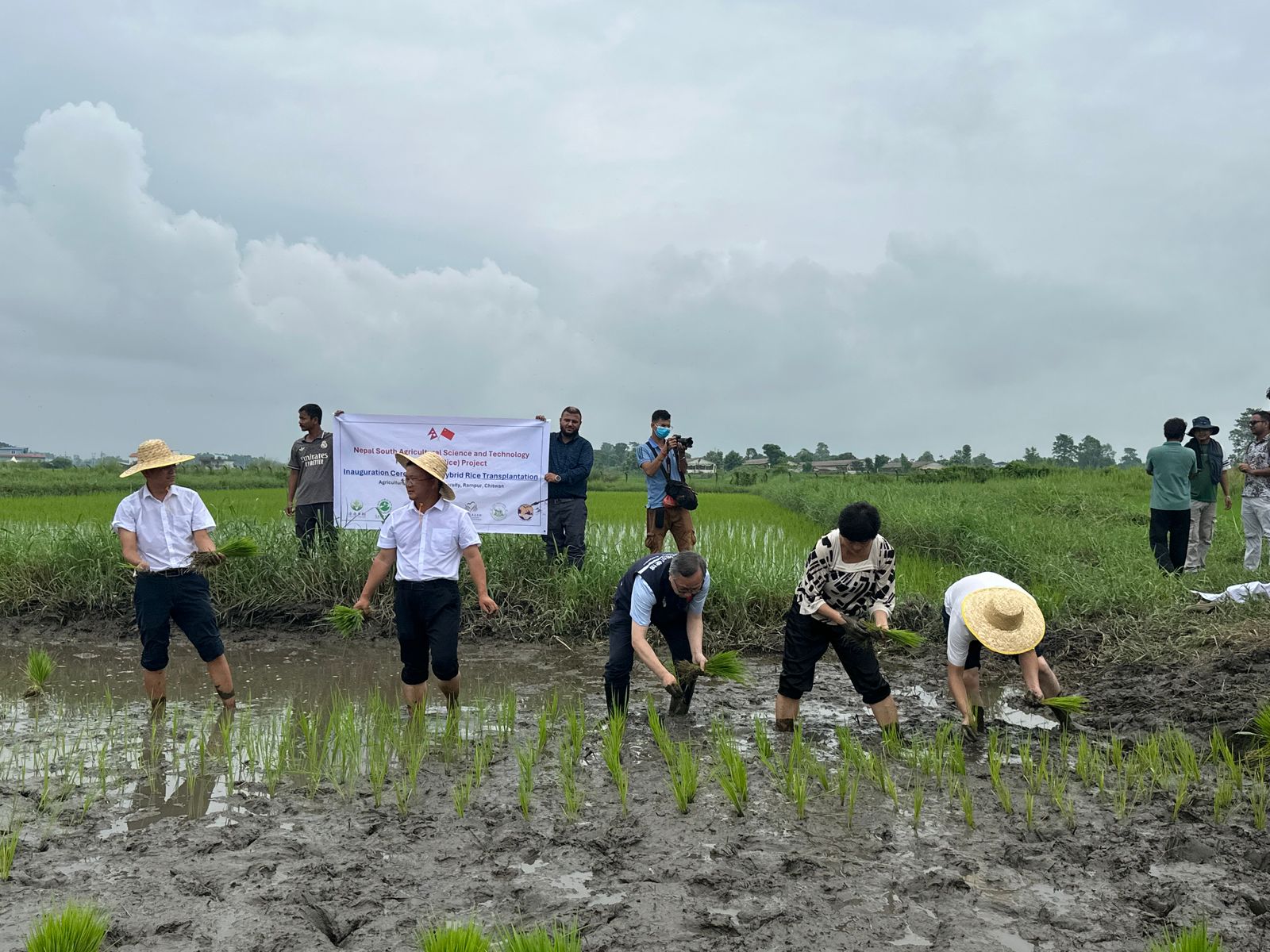
Chitwan – In the fertile fields of Chitwan’s Agriculture and Forestry University in Rampur, something special is growing, and it might just shape the future of Nepal’s rice harvests. With support from China’s Chongqing Academy of Agricultural Sciences, a vibrant “hybrid rice planting ceremony” was held, introducing 37 Chinese-developed hybrid rice varieties alongside one Nepali-developed type and eight popular local varieties.
The event drew an audience that included China’s Ambassador to Nepal, Chen Song, who personally joined the planting. Each variety was sown in small test plots using 300 grams of seed, turning the university grounds into a living laboratory of rice diversity.
Bharatpur Metropolitan City Mayor Renu Dahal highlighted that this milestone stems from an agreement made during former Prime Minister Pushpa Kamal Dahal “Prachanda’s” visit to China. She called the project a “cornerstone” for boosting national rice output, noting that Chitwan and Jhapa already lead the country in paddy production.
Ambassador Chen said China was proud to gift Nepal seeds from its hybrid rice, developed over 70 years of agricultural innovation. He expressed confidence that the project could help realize Nepal’s dream of higher yields in the years to come.
Agriculture and Forestry University Vice-Chancellor Prof. Dr. Sharada Thapaliya credited the success of the initiative to the combined efforts of the Chinese government, Bharatpur Metropolitan City, agricultural experts, and partner organizations.
Project coordinator Raju Baral explained that the test will determine which hybrid rice varieties perform best in Nepali conditions. The winning types could be cultivated in other parts of the country, with farmers receiving training to make the most of the seeds.
Currently, only one hybrid rice variety, Hardinath Hybrid-1, is produced domestically, while most farmers rely on imported hybrids. If this collaboration delivers on its promise, that could change and Nepal’s rice fields could see a new green revolution.