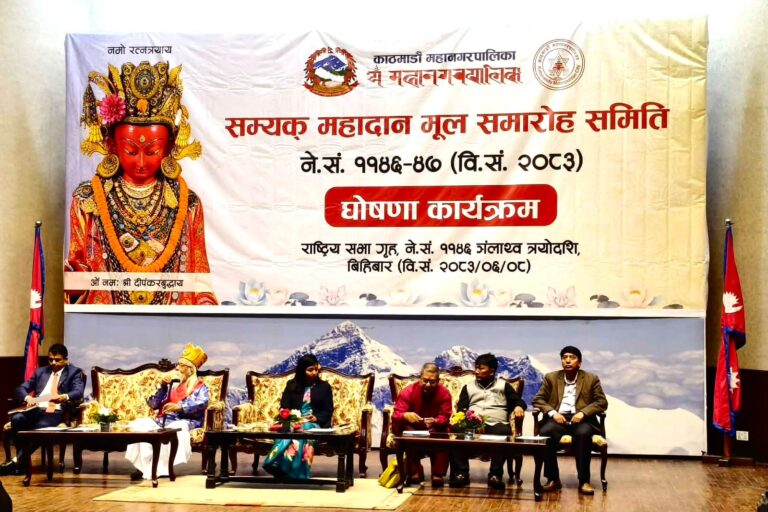
A rare and spiritually significant Lasta Samyak Mahadan, being observed after a gap of 100 years, is scheduled to take place on Poush 30 and Magh 1 in Nyakhachok, Lalitpur. The event represents one of the most elaborate Newa Buddhist almsgiving traditions, rooted in centuries-old religious practice, family lineage, and communal participation.
Samyak Mahadan, known as the festival of Dipankara Buddha, is celebrated every five years in Patan (Lalitpur). In Kathmandu, the festival takes place at Darbar Square and Bhuikhel in Swayambhu once every 12 years, while in Bhaktapur, it is observed annually, making it a continuous cultural highlight across the region.
Despite the festival taking place last year as per the customary traditions in the gap of 5 years, this year, the festival is being observed this year as well, marking its centenary year.
Preparatory Rituals Begin with Hali Pata Bwaykegu
As part of the formal preparations for the centennial Samyak Mahadan, the ritual Halimpata Bwaykegu, which involves invoking Buddhas and deities, was conducted at Nyakhachok, Lalitpur. This rite marks the ceremonial beginning of the Mahadan sequence.
In accordance with tradition, Panjadan will be distributed to Tathagatas, deities, monks, Vajracharyas, Shakyas, and all present devotees using rice stored at Sano Nag Falcha in Nagbahal, specifically Soh Muri (six muris) of rice.
Generations of Meritorious Deeds and Religious Contributions
The organizing family has a long legacy of religious, cultural, and philanthropic contributions. Among the notable meritorious works carried out across generations are:
Nepal Sambat 1037: Completion of Panjadan (Narang)
Nepal Sambat 1047: Establishment of Dipankara Buddha and organization of Samyak Mahadan at Lagankhel; installation of a silver Ajima Devi at Boudha (Khaasti)
Nepal Sambat 1049: Complete renovation of Lokakirti Mahavihar (Na Bahi)
Bikram Sambat 2006: Full renovation of I: Bahi Stupa
Nepal Sambat 1058: Installation of Dharmadhatu in front of the family residence by Shri Laxmi Narsinghju
Complete renovation of Thyaka Aagan Chhe, Nyakhachok
Nepal Sambat 1068: Establishment of Manya and Dalupa at Ta: Bahal by Shri Bekha Man Singh Shakya
Nepal Sambat 1077: Donation of Shakya Singh Vihar at Thaina by Shri Kul Narsingh Shakya
Donation of residential houses to gurus and disciples by Shri Kul Narsingh Shakya
Bikram Sambat 2041: Donation of three ropanis of land with World Peace Vihar in New Baneshwor by Sushri Chaitramaya Shakya
Bikram Sambat 2042: Donation of 7 ropanis 6 annas of land at Shankhamul for the International Buddhist Bhavana Center
Bikram Sambat 2058: Installation of Chakrabara statue at I: Bahi Aagan Chhema by Shri Ratna Narsingh Shakya
Bikram Sambat 2070: Donation of 15 annas 2 paisa land and installation of a chaitya at the Dhamma Hall of the International Buddhist Bhavana Center, Shankhamul
Kathina Dana organized in 2072 at the International Buddhist Bhavana Center, 2079 at World Peace Vihar, and 2081 at Panditaram Meditation Center, Lumbini
Donation of one ropani land at Lakure Bhanjyang for branch expansion of the International Buddhist Bhavana Center
In Bikram Sambat 2082, Shreemati Chandra Devi Shakya provided full financial support for the construction of a room at the Lakure Bhanjyang Meditation Center in memory of late Dharma Narsingh Shakya.
Main Samyak Mahadan Observance
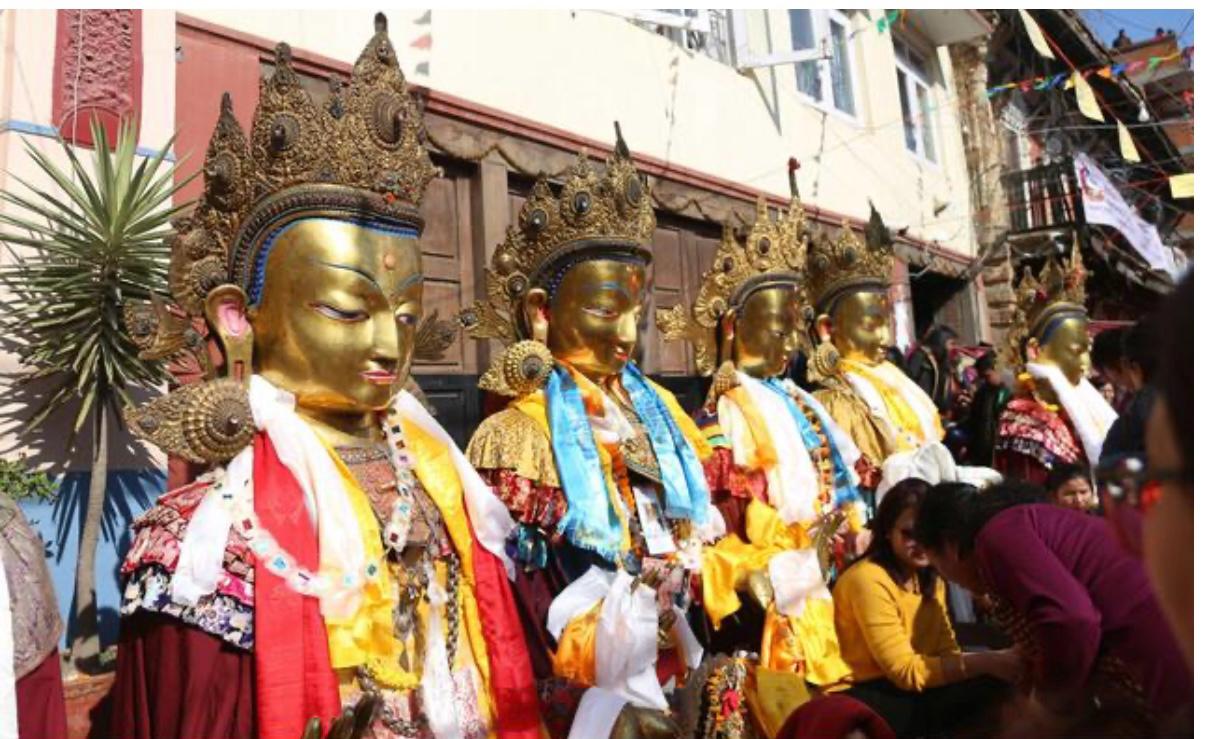
With a formal vow (Sankalpa), the Lasta Samyak Mahadan will be organized on Magh 1, Nepal Sambat 1146, Thursday. On Poush 30, a total of 125 figures, including Dipankara Buddhas from all bahas and bahis of Lalitpur, previously established Dipankara Tathagatas, Basundhara Devi, and other deities, will be welcomed and seated ceremonially in front of Bhaskarvarn Mahavihar, Nyakhachok.
On Magh 1, all family members will perform formal darshan and puja. Panjadan will also be distributed to all present Shakya and Vajracharya priests after the completion of Chudakarma. The entire religious undertaking is dedicated to the liberation of ancestors and to wishing peace, happiness, and well-being for all sentient beings.
The Mahadan will conclude with large public participation, structured almsgiving, and proper ritual completion. The Shri Lama Aju family has extended a warm and respectful invitation to all devotees and the general public to participate in this historic religious occasion.
Detailed Ritual Schedule
Key events include:
Kartik 27 (Thursday): Basundhara Sthapana Puja
Poush 17 (Thursday): Bhutu Puja, Aang Puja
Poush 24 (Thursday): Hali Pata Bwaykegu, Mari Na Swakegu, Bhalin Chiyugu
Poush 28 (Monday): Yachi Swanegu
Poush 30 (Wednesday): Basundhara Yathay Kal Puja Vanegu, Basundhara Lasavya Kaa Vanegu, Dho Pi Lasakusa Yana Dukayagu
Magh 1 (Thursday): Main Samyak Mahadan
Magh 2: Halimpata Likayugu,
Magh 3: Kwayna Puja Yaygu
About Samyak Mahadan
Samyak Mahadan, also known as the festival of Dipankara Buddha, is a major Newa Buddhist almsgiving festival. In Patan (Lalitpur), it is held once every five years at Nagbahal, while in Kathmandu it is observed every 12 years at Durbar Square and Bhuikhel, Swayambhu, and annually in Bhaktapur. Historical accounts trace the first Samyak Mahadan to Nepal Sambat 135 (1015 AD).
The festival honors Dipankara Buddha, who predicted the enlightenment of Gautam Buddha. Its origins are linked to the Licchavi period, later systematized through royal and community patronage. Though economic and land changes altered its frequency, its religious and cultural significance remains intact.
The centennial Lasta Samyak Mahadan stands as a rare convergence of faith, history, and living heritage, reaffirming Lalitpur’s enduring role as a center of Newa Buddhist tradition.
“Bhavatu sabba mangalam — May all beings be blessed.”