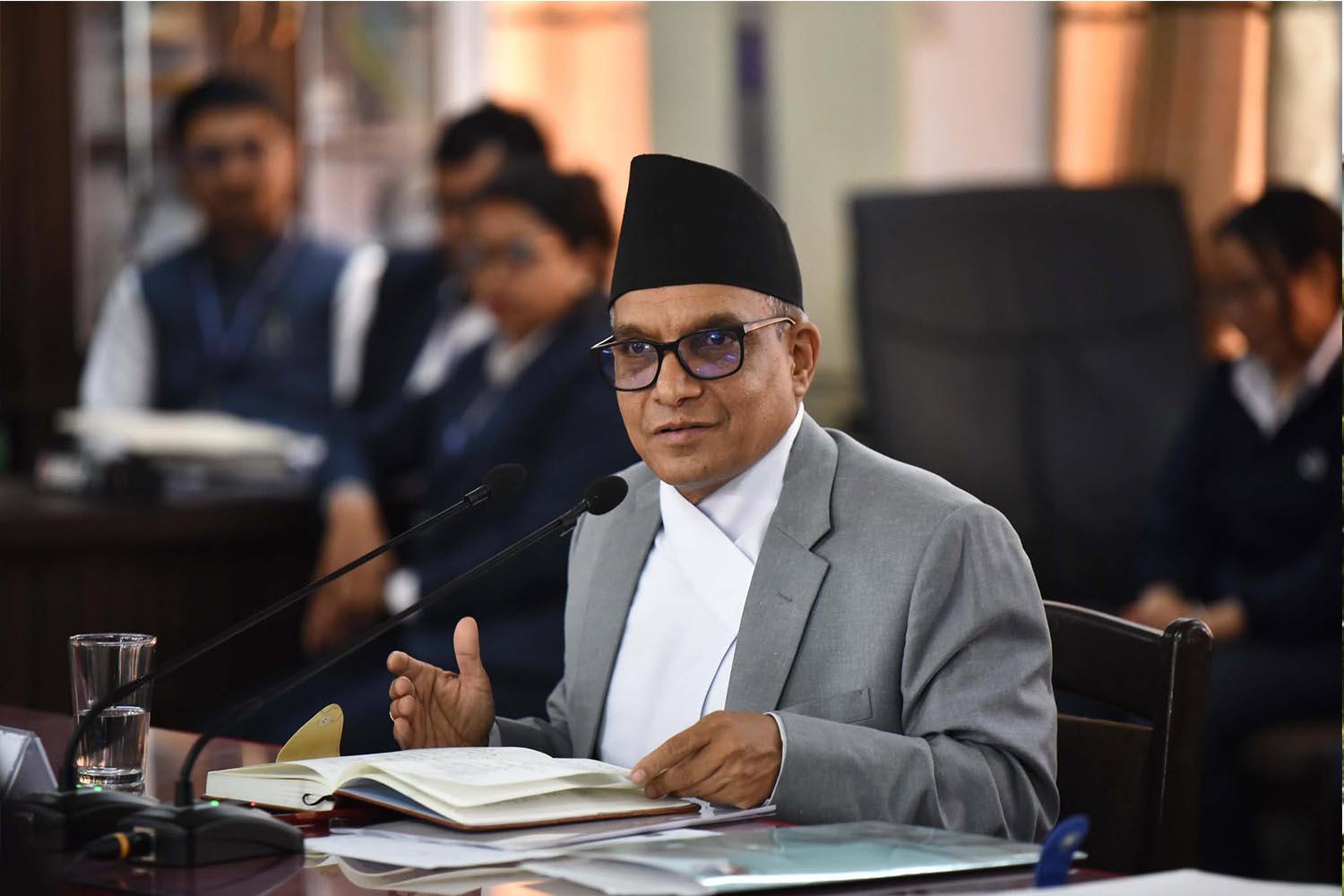
Kathmandu-Dr. Manoj Kumar Sharma has officially assumed office as Nepal’s 33rd Chief Justice after receiving endorsement from the Parliamentary Hearing Committee and taking the oath of office from President Ramchandra Paudel. His appointment marks the beginning of a new phase for Nepal’s judiciary at a time when questions surrounding judicial independence, institutional credibility and internal reform remain at the centre of public debate.
Under Article 129(4) of Nepal’s Constitution, Sharma will serve a six-year term until 4 Jestha 2089, making him one of the longest-serving Chief Justices in recent decades. His rise to the country’s top judicial post is itself considered unusual, as he was fourth in the seniority order among Supreme Court justices. Legal and political observers say the appointment has broken traditional practices that generally prioritised seniority in selecting the Chief Justice.
Following the oath-taking ceremony, Sharma publicly committed himself to protecting judicial independence and impartiality. Speaking to journalists at the Supreme Court, he stressed that no compromise would be made on the autonomy of the judiciary and assured that neither his actions nor his leadership would create doubts about the institution’s neutrality.
“I want to assure everyone that there will be no reason to question the independence of the judiciary during my tenure,” Sharma said shortly after assuming office.
Despite the assurances, his appointment has generated significant discussion among legal experts, lawmakers and the Nepal Bar Association. Critics argue that Nepal’s judiciary has long struggled with allegations of political influence and institutional weakness, making the role of Chief Justice increasingly sensitive.Concerns have also been shaped by past experiences. During the tenure of former Chief Justice Cholendra Shumsher Rana, the judiciary faced intense controversy over alleged political bargaining and interference. The fallout eventually led to protests from legal professionals and Rana’s suspension through impeachment proceedings. That period remains a defining example of how tensions between the executive and judiciary can damage public confidence in state institutions.
Against that backdrop, many observers are closely watching whether Sharma will be able to maintain clear institutional distance from political power. Questions about judicial independence were also raised during the parliamentary hearing process, where lawmakers sought assurances that the courts would continue to act independently even when dealing with controversial government decisions.Constitutional law experts believe Sharma’s greatest responsibility will be restoring trust in the judiciary. According to legal scholar Kashiraj Dahal, the courts must actively defend constitutional supremacy, rule of law and fundamental rights if they hope to regain public confidence.
Another major challenge before the new Chief Justice is internal management within the judiciary itself. In recent weeks, differences among Supreme Court justices became publicly visible over administrative and procedural matters, exposing growing divisions inside the institution. Some legal petitions reportedly faced delays and disagreements during registration and hearing processes, leading to criticism from lawyers and court observers.
Analysts say Sharma will now need to balance constitutional bench formation, administrative authority and professional relationships with fellow judges carefully in order to prevent further institutional fragmentation. Legal professionals have emphasised that internal disputes among judges should never affect the delivery of justice or weaken the credibility of the Supreme Court.At the same time, the judiciary continues to struggle with structural and administrative problems. Several judicial positions remain vacant at the Supreme Court and lower courts, while increasing case backlogs continue to delay justice delivery across the country. Limited manpower, insufficient resources and inefficiencies within court administration have further complicated efforts to improve public service.
In response, Sharma has pledged to focus on judicial reform, including improving court administration and expanding the use of information technology to speed up legal processes. However, legal experts say implementing meaningful reform will require not only administrative efficiency but also stronger accountability and transparency throughout the judicial system.Sharma also faces scrutiny regarding his personal and professional background. Some critics have pointed to his family connection with former Chief Justice Damodar Prasad Sharma and raised concerns about political proximity and influence within judicial appointments. During the parliamentary hearing, Sharma rejected allegations made against him, insisting that accusations questioning his integrity were baseless.
Public expectations remain particularly high because several recent Chief Justices, including Hari Krishna Karki, Bishowambhar Prasad Shrestha and Prakash Man Singh Raut, were generally viewed as maintaining relatively clean and professional public images despite institutional challenges. Observers believe Sharma will be expected to uphold similar standards of integrity and transparency throughout his tenure.Legal experts also stress that reforming Nepal’s judiciary will require merit-based judicial appointments, stronger anti-corruption mechanisms and greater consistency in judicial interpretation. Concerns have frequently been raised over differing verdicts in similar cases, a trend that many believe has weakened public confidence in the fairness and predictability of the justice system.As Dr. Manoj Kumar Sharma begins his tenure, the expectations surrounding his leadership are substantial. Beyond administrative responsibilities, his term is likely to be judged by how effectively he protects judicial independence, restores institutional credibility and addresses long-standing weaknesses within Nepal’s justice system.