From a parliamentary response to a national controversy
Kathmandu-Few issues in Nepal generate as much political sensitivity as questions of national sovereignty, territorial integrity, and border disputes with India.
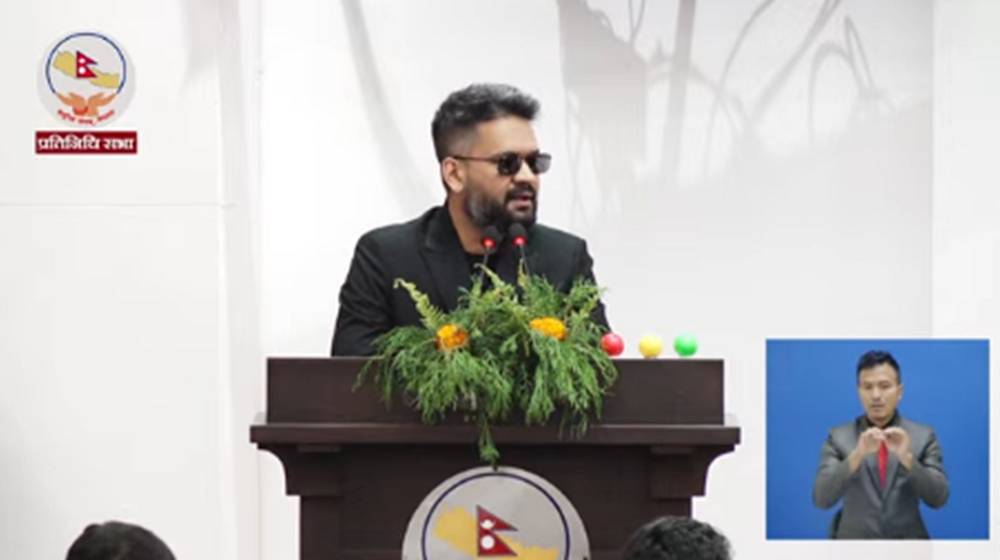
That reality became evident when Prime Minister Balen Shah, while responding to lawmakers in Nepal’s House of Representatives, stated that India had not only occupied Nepali land but that Nepal had also occupied Indian land in several places. The statement immediately triggered one of the most intense political controversies of his premiership.
What might have been intended as a broader call for diplomatic dialogue quickly evolved into a national debate involving Parliament, opposition parties, border experts, former diplomats, constitutional questions, and Nepal’s long-standing territorial disputes with India.
Within 24 hours, the issue had disrupted proceedings in both the House of Representatives and the National Assembly, prompted formal statements from political parties, led to demands for an apology, and reignited public discussion about Kalapani, Lipulekh, Limpiyadhura, and Susta.
Why the remark became so controversial
The controversy is not merely about what the Prime Minister said, but the context in which he said it.
Prime Minister Shah made the statement while responding to questions regarding Nepal’s territorial claims over Kalapani, Lipulekh, and Limpiyadhura,areas Nepal officially claims as part of its sovereign territory.
For critics, this distinction is crucial.Had the Prime Minister been discussing technical issues such as cross-border land use, river-induced shifts in local boundaries, or the practical realities of settlements along the Nepal-India frontier, the statement may have generated less controversy.
Instead, he made the comment while discussing Nepal’s official territorial dispute with India.That immediately raised concerns among opposition leaders and border experts who argued that the statement appeared to place Nepal’s territorial claims and India’s disputed control of certain areas on the same footing.
Parliament turns into a battleground
The day after the statement, opposition parties effectively transformed Parliament into a platform for protest.Members from multiple parties demanded clarification, evidence, or a withdrawal of the remark.The controversy became so intense that parliamentary proceedings were repeatedly disrupted.
Nishchal Rai: “Provide the Evidence”
Nepali Congress Chief Whip Nishchal Rai argued that the Prime Minister’s statement undermined Nepal’s longstanding position on border disputes.
Rai demanded that the government specify exactly which Indian territory Nepal had allegedly occupied.According to him, if such a claim exists, the government should provide detailed evidence down to the exact location. Otherwise, he argued, the Prime Minister should correct the record.
He further warned that such remarks could weaken Nepal’s diplomatic position regarding Kalapani, Lipulekh, and Limpiyadhura by creating the impression that both countries were equally responsible for territorial encroachments.
Gagan Thapa: “Condemnable and highly objectionable”
Nepali Congress President Gagan Thapa described the Prime Minister’s statement as condemnable and highly objectionable.Speaking at a policy and research program, Thapa argued that border disputes are matters of sovereignty, territorial integrity, and national security.According to him, every state maintains carefully developed positions supported by historical evidence and legal arguments.He warned that the Prime Minister’s remarks risked weakening Nepal’s official position at a time when the country continues to claim disputed territories through constitutional and political means.
UML’s strongest criticism
The harshest criticism came from the opposition CPN-UML.
Chief Whip Ain Bahadur Mahar described the statement as “anti-national” and demanded both a correction and a formal apology.Mahar argued that Kalapani, Lipulekh, Limpiyadhura, and Susta are Nepali territories and insisted that Nepal has never occupied even a single inch of Indian land.He accused the Prime Minister of making statements without understanding the historical and legal foundations of Nepal’s territorial claims.UML lawmaker Ram Kumari Jhakri stated that the Prime Minister’s remarks had embarrassed patriotic Nepalis and raised questions about whether the government fully understood the importance of protecting national sovereignty.
RPP and Other opposition voices
Rastriya Prajatantra Party parliamentary leader Gyanendra Shahi demanded documentary proof for the Prime Minister’s claim.He argued that while democratic leaders enjoy freedom of expression, prime ministers carry additional responsibility because their words can have diplomatic consequences.National Assembly member Ranjit Karna went further, giving the government a 24-hour ultimatum to identify the territory Nepal had allegedly occupied or issue a public apology.He also called for the formation of an investigation committee to examine the basis of the Prime Minister’s statement.
National Assembly also revolts
The controversy was not limited to the lower house.When the National Assembly convened, lawmakers from across the political spectrum stood up in protest.The opposition prevented the chamber from moving to its scheduled agenda, forcing repeated interruptions and eventually leading to a temporary suspension of proceedings.
Rajendralaxmi Gaire’s challenge
National Assembly member Rajendralaxmi Gaire questioned the basis upon which the Prime Minister made his remarks.She argued that Nepal’s Parliament had never before heard a prime minister make statements that appeared to support India’s narrative on border issues.Gaire maintained that Nepal has consistently claimed that tens of thousands of hectares of land remain under Indian control and questioned whether the Prime Minister’s statement was intended to appease India.
Ram Kumari Jhakri’s criticism
Jhakri told the National Assembly that many Nepalis felt embarrassed by the statement.According to her, the controversy raised broader questions about whether the government fully appreciates the importance of national identity and territorial integrity.
Tul Prasad Bishwakarma’s position
National Janamorcha lawmaker Tul Prasad Bishwakarma described the statement as anti-national and argued that correcting the record was necessary before moving forward.
The CPN statement
The Communist Party of Nepal (CPN) issued a formal statement through spokesperson Prakash Jwala.The party described the remarks as irresponsible and contrary to Nepal’s sovereignty and territorial integrity.The statement emphasized an important distinction between international border encroachment and cross-border land use. According to the party, local residents farming or owning land across the border is a practical reality in many frontier areas, but such situations should not be confused with state-level territorial occupation.
Foreign Ministry’s damage control
As criticism intensified, Nepal’s Ministry of Foreign Affairs attempted to clarify the Prime Minister’s remarks.The ministry explained that the statement referred to technical issues involving “cross-border occupation” and land use arrangements resulting from the fixed boundary principle applied in river-border regions.According to the ministry, changing river courses and historical settlement patterns have created situations where citizens of one country farm or reside on land technically located within the other country’s territory.However, the clarification failed to end the controversy.Critics argued that such technical realities are fundamentally different from disputes involving Kalapani, Lipulekh, and Limpiyadhura.
The historical context: Why kalapani matters
The roots of the dispute stretch back more than two centuries.Nepal bases its claim primarily on the 1816 Treaty of Sugauli, signed after the Anglo-Nepalese War.The treaty established the Kali River as Nepal’s western boundary.The central disagreement concerns the source of the Kali River.
Nepal argues that the river originates in Limpiyadhura and cites historical maps issued during the East India Company period as evidence.India, however, relies on later survey maps and identifies a different source near Lipulekh.This disagreement creates competing territorial claims over Kalapani, Lipulekh, and Limpiyadhura.The issue intensified after the 1962 Sino-Indian War when Indian security forces established a presence in the Kalapani area for strategic reasons.Although Nepal later protested the deployment, India maintained its position, and the dispute remains unresolved.In 2020, Nepal formally incorporated the disputed territory into its new political map, further institutionalizing its claim.
Susta and the new dimension
The controversy gained another layer when reports emerged from Susta in Nawalparasi.Local officials reported that India’s Sashastra Seema Bal (SSB) had objected to work on a river embankment project along the Narayani River.Although there is no official evidence directly linking the incident to the Prime Minister’s statement, the timing intensified political concerns.Some critics argued that the statement could provide India with additional diplomatic arguments in future border discussions.
Border experts enter the debate
Several prominent border experts, including Buddhi Narayan Shrestha, Pitamber Sharma, Narendra Khanal, Jagat Bhusal, Prabhakar Sharma and Dwarikanath Dhungel, issued a joint statement expressing concern.They noted that no official Nepal–India boundary commission report has concluded that Nepal occupies Indian territory.The experts requested that the Prime Minister clarify the factual basis of his remarks and urged the government to maintain consistency with Nepal’s officially published political map.
The larger piplomatic question
Beyond the immediate controversy lies a broader issue.Border disputes are not simply technical disagreements over maps. They involve national identity, historical interpretation, strategic interests, diplomacy, and domestic politics.Supporters of the Prime Minister argue that acknowledging complexities along the border could create space for more practical diplomatic engagement.Critics, however, believe that public statements from a head of government must be carefully aligned with official national positions, particularly on issues involving territorial sovereignty.For many opponents, the concern is not merely what was said but how it could be interpreted internationally.
Prime Minister Balen Shah’s remarks have triggered one of the most significant political debates on Nepal’s border policy in recent years.The controversy has united opposition parties, disrupted parliamentary proceedings, drawn criticism from border experts, prompted intervention by the Foreign Ministry, and revived longstanding questions surrounding Kalapani, Lipulekh, Limpiyadhura, and Susta.Whether the issue ultimately fades or reshapes Nepal’s diplomatic discourse remains uncertain.What is clear is that a single statement in Parliament has reopened one of the most sensitive chapters in Nepal–India relations, reminding both countries that border questions remain as politically powerful today as they were decades ago.