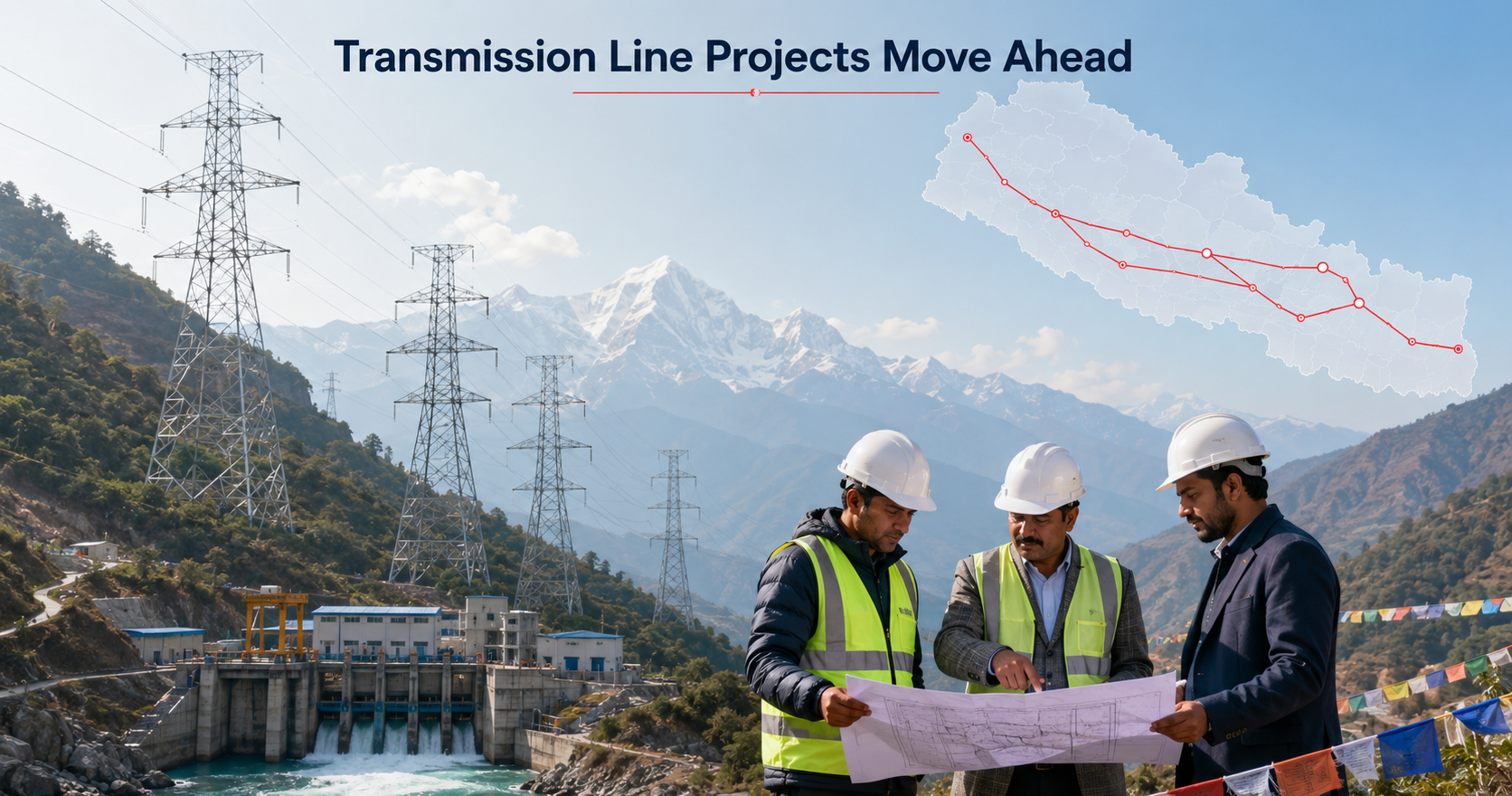
Kathmandu: Nepal Electricity Authority has moved ahead with four major transmission line projects through a tariff-based competitive bidding system under the BOOT model, opening a new path for private sector participation in transmission infrastructure development.
A total of 18 national and international companies and consortiums from Nepal, India, China, the United States and other countries have submitted expressions of interest for the projects. The strong participation of Nepali companies and Nepal-led consortiums shows the growing confidence and capacity of the domestic private sector in large-scale energy infrastructure.
Nepali participants include Power Transmission Company Nepal, High Himalaya Hydro Construction, Shivshree–Danfe Joint Venture, Sigma Construction and Hulas Steel Industries, Universal–Mountain Consortium Nepal, and several consortiums involving Balefi Hydropower, Litmus Cable, Sharma and Company, Hulas Steel and other partners.
International companies have also shown strong interest. India’s Power Grid Corporation of India Limited, Ashoka Buildcon Limited, and other companies from India, China and the United States have applied for different transmission line packages.
Under the BOOT model, selected developers will be responsible for the study, financing, construction, operation and maintenance of the transmission lines. After the agreed operating period, the infrastructure will be handed over to Nepal Electricity Authority. Selection will be based on technical capacity, financial strength, project understanding and competitive transmission service charges.
The four projects include the Sheetalpati–Inaruwa 400 kV line, Tingla–New Khimti–Sunkoshi Hub–Dhalkebar 400 kV line, Dandakhet–Burtibang 132 kV line, and Ridi–Tamghas 132 kV line. These projects are expected to support electricity evacuation from major hydropower corridors and strengthen Nepal’s internal power supply system.
According to the submitted details, the Ridi–Tamghas project received the highest number of proposals with 14 applications, followed by Dandakhet–Burtibang with 12, Sheetalpati–Inaruwa with 9, and Tingla–New Khimti–Sunkoshi Hub–Dhalkebar with 7 applications.
The next phase will include technical and financial evaluation of the expressions of interest. Shortlisted companies will then move forward to the proposal stage. The process is expected to make Nepal’s transmission line development more competitive, investment-friendly and important for the country’s long-term energy security.