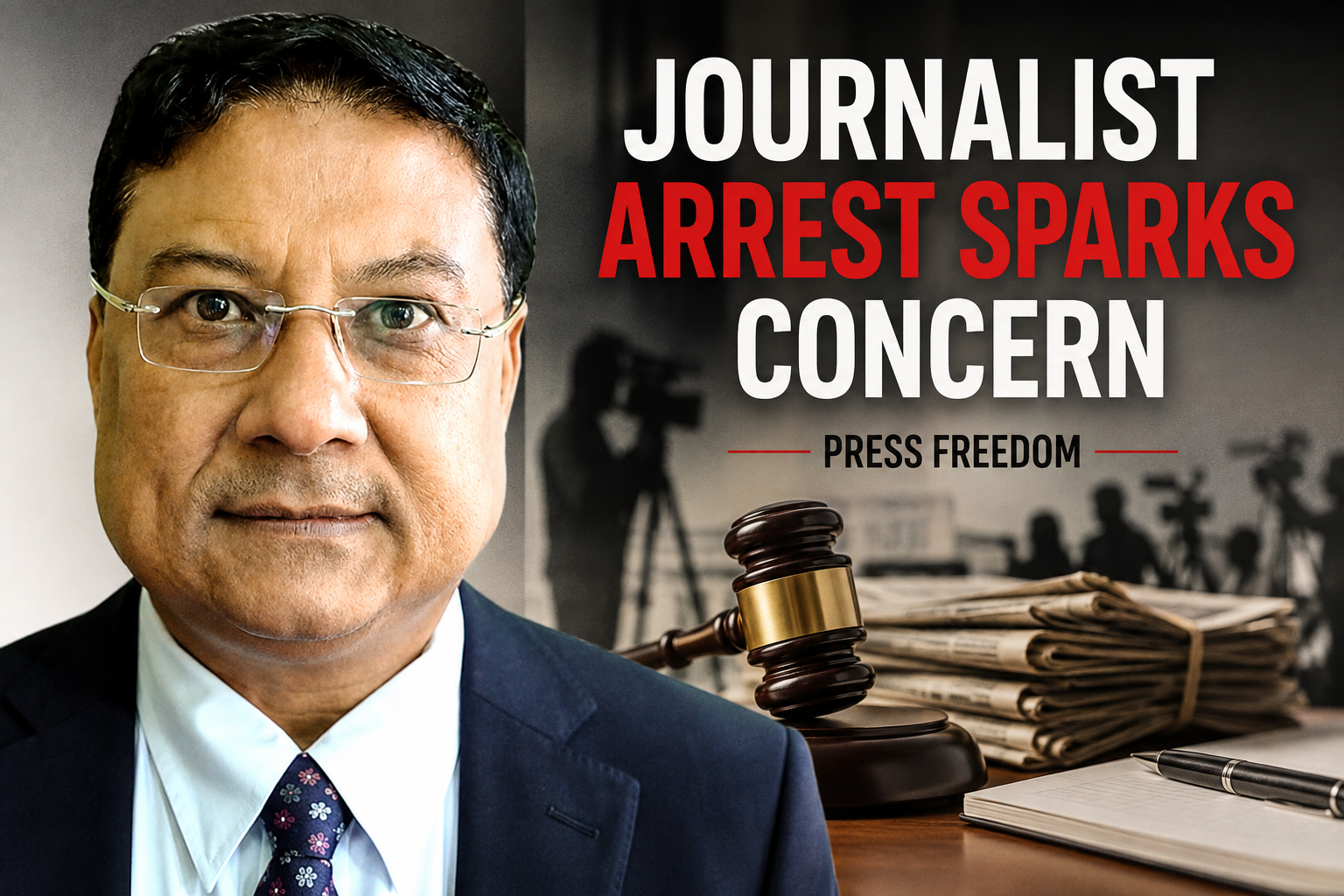
The arrest of senior journalist and Jana Aastha weekly editor Kishor Shrestha has raised an important question about how Nepal should handle disputes over published news reports: through criminal proceedings or through the country’s established press-regulatory mechanisms.
Shrestha, a former acting chairperson of the Press Council Nepal, was arrested from his residence in Kusunti on Wednesday night by a team from the Kathmandu Police Range. The Kathmandu District Court has allowed police to keep him in custody for three days for investigation into an alleged violation of the Privacy Act 2018.
The Press Council Nepal has expressed serious concern over the arrest and the confiscation of office equipment during what it described as an armed raid. In a statement issued Thursday, the council’s senior administrative officer and spokesperson, Deepak Khanal, said the council was concerned about the manner in which the journalist was arrested. It also appealed to concerned parties to approach the Press Council if they have grievances over published news reports.
The Federation of Nepali Journalists has demanded Shrestha’s unconditional release. It argued that complaints concerning news reports can be addressed within the jurisdiction of the Press Council and that deploying state machinery to arrest a journalist over a news report runs counter to press freedom and freedom of expression.
The federation’s position deserves serious consideration. A free press does not mean journalists are above the law. Journalists and media organisations must be accountable for accuracy, ethics and the protection of individual rights. But accountability should also follow clear, proportionate and legally established procedures that do not unnecessarily intimidate the media.
The Press Council, for its part, has stopped short of directly condemning Shrestha’s arrest. Its statement emphasised that press freedom must be respected and responsibly exercised, while also noting that the council is concerned about the conduct, professional dignity and working practices of journalists and media workers.
That balancing act is important. Press freedom cannot be a shield against legitimate complaints, particularly when questions of privacy and personal dignity are involved. At the same time, criminal law should not become the default response to disputes arising from journalism when specialised regulatory and legal remedies are available.
The immediate controversy stems from a report published on Jana Aastha’s website on August 10, titled “Honorable MP’s Lip Kiss with Another Woman”. The report referred to Rastriya Swatantra Party lawmaker Amarkant Chaudhary of Saptari-3 and a woman identified as Deepika Singh. It published a photograph purportedly showing the married lawmaker kissing Singh and also included video clips of her.
The report claimed that Singh had assisted Chaudhary during the March 5, 2026 House of Representatives election and accompanied him during the campaign. It further claimed that their relationship had subsequently deteriorated and that Singh had posted the photograph on social media.
The public should be cautious about treating the allegations contained in the report as established facts. Whether the publication violated privacy law, journalistic standards or other legal provisions is ultimately a matter for due process and the competent authorities to determine.
But the larger issue extends beyond one journalist, one publication or one controversial report. Nepal’s democratic institutions must be able to protect both individual privacy and the freedom of the press. These principles are not mutually exclusive.
If a media report causes harm, those affected should have accessible avenues for redress. Likewise, journalists must be able to report on matters of legitimate public interest without fear that a disputed story will automatically result in arrest.
The Shrestha case therefore presents an opportunity to reaffirm a basic democratic principle: press freedom requires responsibility, but accountability must not become a substitute for press freedom. The credibility of Nepal’s institutions will depend on whether both principles can be protected at the same time.