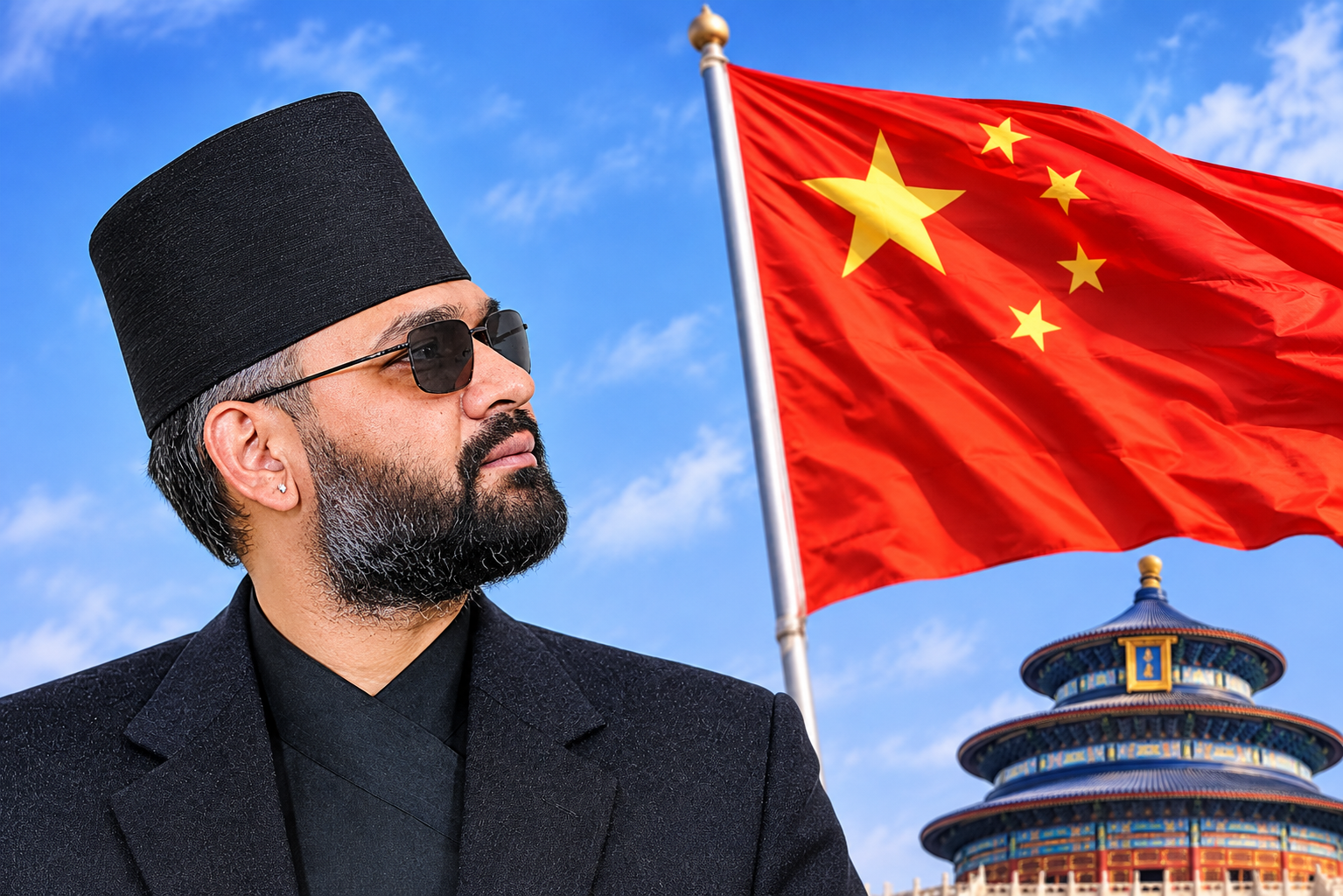
As Balen sits down with India's leadership in New Delhi, his party's lawmakers are engaging with China's political establishment. The two parallel diplomatic tracks offer an early glimpse of a government seeking to engage both neighbours while keeping Nepal's national interests at the centre. Whether Beijing becomes Shah's next official destination may be the next major test of this evolving diplomatic approach.
Kathmandu – Prime Minister Balendra Shah’s foreign policy appears to be entering a new phase, with Nepal simultaneously deepening diplomatic engagement with India and China. While Shah is in New Delhi on his first official bilateral visit abroad as prime minister, a 20-member delegation of lawmakers from his ruling Rastriya Swatantra Party (RSP) is in China for political and diplomatic exchanges. The parallel engagements have drawn attention to Shah’s changing approach towards foreign relations, particularly his evolving position on China and the possibility of a future official visit to Beijing.
When Shah assumed office in March 2026, he had indicated that he would not undertake foreign visits during his first year as prime minister. China had extended an invitation soon after his appointment, but preparations for the visit were reportedly put on hold following his initial position.
His subsequent engagement with foreign representatives, participation in the United Nations General Assembly in September and now his bilateral visit to India indicate a shift from that earlier approach. With Beijing renewing its efforts to host him, a visit to China could become another important step in his diplomatic calendar.
A different approach towards China?
Shah’s recent instructions to the China-bound RSP delegation provide an important indication of how his government wants to approach relations with Beijing. Before their departure, Shah met the 20 lawmakers and urged them to place Nepal’s national interests at the centre of their discussions. He reportedly advised them to engage confidently with Chinese counterparts, clearly communicate Nepal’s concerns and explore practical areas where the country could benefit from China’s development experience and cooperation.
He also cautioned the delegation against treating the visit as merely a sightseeing opportunity, asking its members to focus on substantive engagement in technology, trade, tourism, economic development and agricultural modernisation.
More significantly, Shah asked the lawmakers to examine how Nepal could benefit from China’s Belt and Road Initiative (BRI), an issue that has remained contentious in Nepal because of concerns over financing arrangements, implementation and debt sustainability.
According to reports, he encouraged the delegation to explore whether financing arrangements for certain projects, including loans, could be negotiated on more favourable terms, potentially including grants. He also asked them to understand why some previously agreed projects had failed to move forward.
These instructions suggest that Shah is not necessarily dismissing cooperation with China but wants Nepal to approach it from a position of confidence and with clearly defined national priorities. His message also reflects an emphasis on negotiating practical benefits rather than accepting bilateral proposals without scrutiny.
BRI: A possible turning point?
The BRI question could become central to any future high-level engagement between Kathmandu and Beijing.
Nepal joined the initiative in 2017, but its implementation has faced prolonged discussions over project selection, financing, investment models and institutional arrangements. The Pokhara International Airport, the proposed cross-border railway and other connectivity projects remain part of the wider debate about Nepal-China cooperation.
Shah’s reported instructions to the lawmakers to examine potential benefits from BRI are particularly significant because his government has so far maintained a cautious public position on the initiative.
Rather than making an immediate commitment, the government appears interested in understanding the financial and economic implications of proposed projects and securing arrangements that serve Nepal’s interests.
For Beijing, this could offer an opportunity to reopen discussions at the political level. For Kathmandu, it could provide an opportunity to seek better financing terms, accelerate stalled projects and identify areas where Chinese cooperation can contribute to national development.
Beijing renews efforts to bring Balen
China’s interest in hosting Shah has become more visible as his India visit approaches.
Chinese Ambassador to Nepal Zhang Maoming has recently intensified engagement with senior government officials. He met Foreign Minister Shishir Khanal and Finance Minister Swarnim Wagle on November 19, with the possibility of a prime ministerial visit reportedly raised during the diplomatic discussions.
China had already invited Shah shortly after he became prime minister. With the earlier proposal put on hold, Beijing is now renewing efforts to facilitate his visit.
The Chinese Embassy’s public account of Ambassador Zhang’s November 19 meeting with Finance Minister Wagle highlighted bilateral relations, post-disaster reconstruction and port cooperation, as well as stronger cross-border connectivity. It did not publicly mention BRI or a confirmed prime ministerial visit.
Nevertheless, the renewed diplomatic engagement suggests that Beijing is interested in building direct political understanding with Shah’s government.
A visit by the Nepali prime minister could provide an opportunity to discuss BRI, infrastructure connectivity, trade, investment, tourism and broader bilateral cooperation.
New ambassador in Beijing: Kathmandu prepares for renewed engagement
The appointment of Nepal’s new ambassador to China, Dr Kalyan Raj Sharma, who assumed office in Beijing on November 19, adds momentum to the possibility of Prime Minister Balendra Shah’s China visit. With Nepal’s diplomatic representative now in place, the government is prepared to make the necessary arrangements to facilitate high-level engagement with Beijing, should the visit move forward. His appointment comes amid China’s renewed efforts to invite Shah and growing Nepal–China engagement.
Party-to-party diplomacy alongside official state engagement
Another notable feature of the current diplomatic landscape is the nature of the RSP delegation’s China visit.
The 20-member delegation is travelling at the invitation of the Communist Party of China (CPC), making it primarily a party-to-party engagement rather than an official government delegation representing Nepal in bilateral state negotiations.
The distinction is important. While Shah is conducting official diplomatic engagement with India, members of his ruling party are building political connections and learning about China’s governance, economic development, public service delivery and institutional structures.
The delegation’s programme includes visits to Beijing, Hangzhou and Sichuan, alongside exchanges with Chinese political and administrative institutions.
This arrangement allows the ruling party to establish direct institutional connections with the CPC while the government continues its formal diplomatic engagement with neighbouring countries.
It also offers RSP lawmakers an opportunity to study China’s development experience and consider which aspects might be relevant to Nepal.
The parallel engagements have led to interpretations among diplomatic observers that Shah’s government may be pursuing a pragmatic approach: maintaining high-level state relations with India while strengthening political connections with China through the ruling party.
However, this should not automatically be interpreted as a coordinated diplomatic arrangement between the two countries or evidence that either government has been given assurances.
From earlier reservations to pragmatic engagement
Shah’s evolving approach is particularly interesting given his earlier political decisions as Kathmandu mayor.
During his mayoral tenure, he reportedly declined certain China-related engagements, including a proposed visit of tourism promotion and culture exchange in Beijing, and refused to provide public space for New Year celebrations. Those decisions attracted attention and contributed to questions about his approach towards China.
However, the responsibilities of a metropolitan mayor and a national prime minister are different. As head of government, Shah must consider Nepal’s economic interests, development requirements, international partnerships and geopolitical position.
His recent instructions to RSP lawmakers demonstrate that engagement with China is now being approached as an important subject of national economic and diplomatic interest.
Rather than interpreting his earlier decisions as a permanent position on China, the latest developments suggest that his approach is evolving with the responsibilities of national leadership.
Can Nepal maintain a balance between India and China?
Nepal’s geographical position between India and China makes its foreign policy particularly sensitive. Both neighbours are important development partners, while their economic and strategic interests in the region sometimes overlap.
India remains Nepal’s largest trading partner and a major source of investment, energy cooperation, transit and employment opportunities. China, meanwhile, is an important partner in infrastructure, trade, tourism, connectivity and development cooperation.
Shah’s first bilateral visit to India is therefore significant, but it does not necessarily indicate a departure from engagement with China. Similarly, a future visit to Beijing would not automatically signal a shift in Nepal’s relationship with New Delhi.
Some diplomatic observers may interpret the parallel engagements as an attempt by Shah to maintain constructive relations with both neighbours while avoiding an exclusive alignment with either side.
The prime minister’s challenge will be to translate this approach into concrete outcomes, ensuring that Nepal’s sovereignty, economic interests and independent foreign-policy priorities remain central to negotiations.
Will Balen visit Beijing next?
With China renewing its invitation and the prime minister encouraging his party’s lawmakers to explore areas of cooperation, the possibility of a future Beijing visit has gained fresh diplomatic significance.
Although no official date or confirmation has been announced, Shah’s changing approach to foreign travel and his recent instructions to the China-bound delegation suggest that engagement with Beijing is becoming an increasingly important part of his government’s foreign-policy agenda.
A possible visit could open discussions on BRI, cross-border connectivity, infrastructure investment, trade, tourism and the implementation of previously agreed projects.
For Beijing, hosting Shah would offer an opportunity to establish direct relations with Nepal’s new political leadership. For Kathmandu, it would provide a platform to communicate its priorities and seek mutually beneficial cooperation.
Ultimately, the significance of Shah’s emerging diplomatic approach will depend not on the order in which he visits India’s and China’s capitals, but on what Nepal achieves through those engagements.