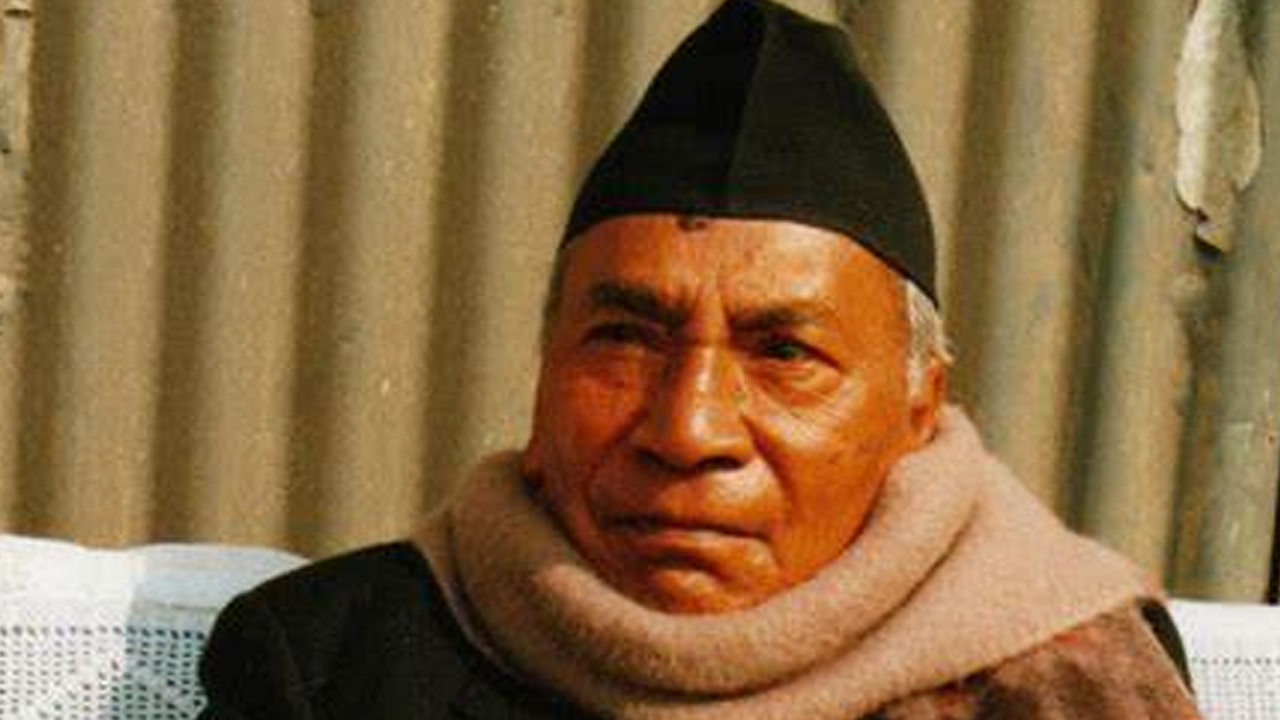
Kathmandu – Nepal is commemorating the 112th birth anniversary of Ganesh Man Singh, a prominent democratic leader who served as the supreme commander of the 1990 People’s Movement that restored multiparty democracy in the country.
Remembered for his courage, sacrifice and commitment to democratic values, Singh played a major role in Nepal’s struggle against the Rana regime and the later Panchayat system. He remains widely respected for refusing the position of prime minister after the success of the 1990 movement, instead recommending fellow leader Krishna Prasad Bhattarai for the role.
Born on Kartik 24, 1972 BS, in Chhetrapati, Kathmandu, Singh became politically active through Nepal Praja Parishad, the country’s first political party, established in 1997 BS. His involvement in activities against the Rana regime led to his arrest and imprisonment.
Singh later escaped from Bhadragol Prison and travelled to India, where he developed political ties with BP Koirala. He played an important role in expanding the Nepali National Congress, established in 2003 BS, and strengthening Nepal’s democratic movement.
During the 1951 revolution, Singh led armed resistance on the Birgunj front. He subsequently became an influential figure in the Nepali Congress and worked closely with BP Koirala to promote democratic governance.
Following Nepal’s first general election in 1959, Singh served as a senior minister in the elected government. However, when King Mahendra dissolved the democratic government on December 15, 1960, Singh was arrested and spent approximately eight years imprisoned in Singha Durbar and Sundarijal.
After his release in 1968, Singh went into exile in India, where he continued organising political activities against the Panchayat system. He returned to Nepal alongside BP Koirala on December 30, 1976, under the policy of national unity and reconciliation but was arrested again upon arrival.
Singh also played a leading role during the 1979 student movement and the subsequent national referendum. Following BP Koirala’s death, he emerged as a senior leader of the Nepali Congress and led the party’s civil disobedience movement in 1985.
His most significant political contribution came during the 1990 People’s Movement, when he helped bring the Nepali Congress and left-wing political parties together in a united campaign against the Panchayat system.
As the movement’s supreme commander, Singh played a central role in mobilising political forces and public support. The movement ultimately led to the restoration of multiparty democracy in Nepal.
Despite his major contribution to the democratic transition, Singh declined King Birendra’s offer to become prime minister. His decision to support Krishna Prasad Bhattarai instead became one of the most widely remembered examples of personal sacrifice in Nepalese politics.
Singh died on Asoj 2, 2054 BS. His contributions to democracy, political unity and public service continue to be remembered across the country.
The Sundarijal detention centre, where Singh and several other democratic leaders were imprisoned, was later converted into the BP Museum in 2004. The museum preserves the history of Nepal’s democratic struggle and honours leaders including Singh and BP Koirala.
To mark his birth anniversary, Nepali Congress organisations, affiliated groups and institutions dedicated to preserving his legacy are organising commemorative programmes and paying tribute to his contributions to Nepal’s democratic development.