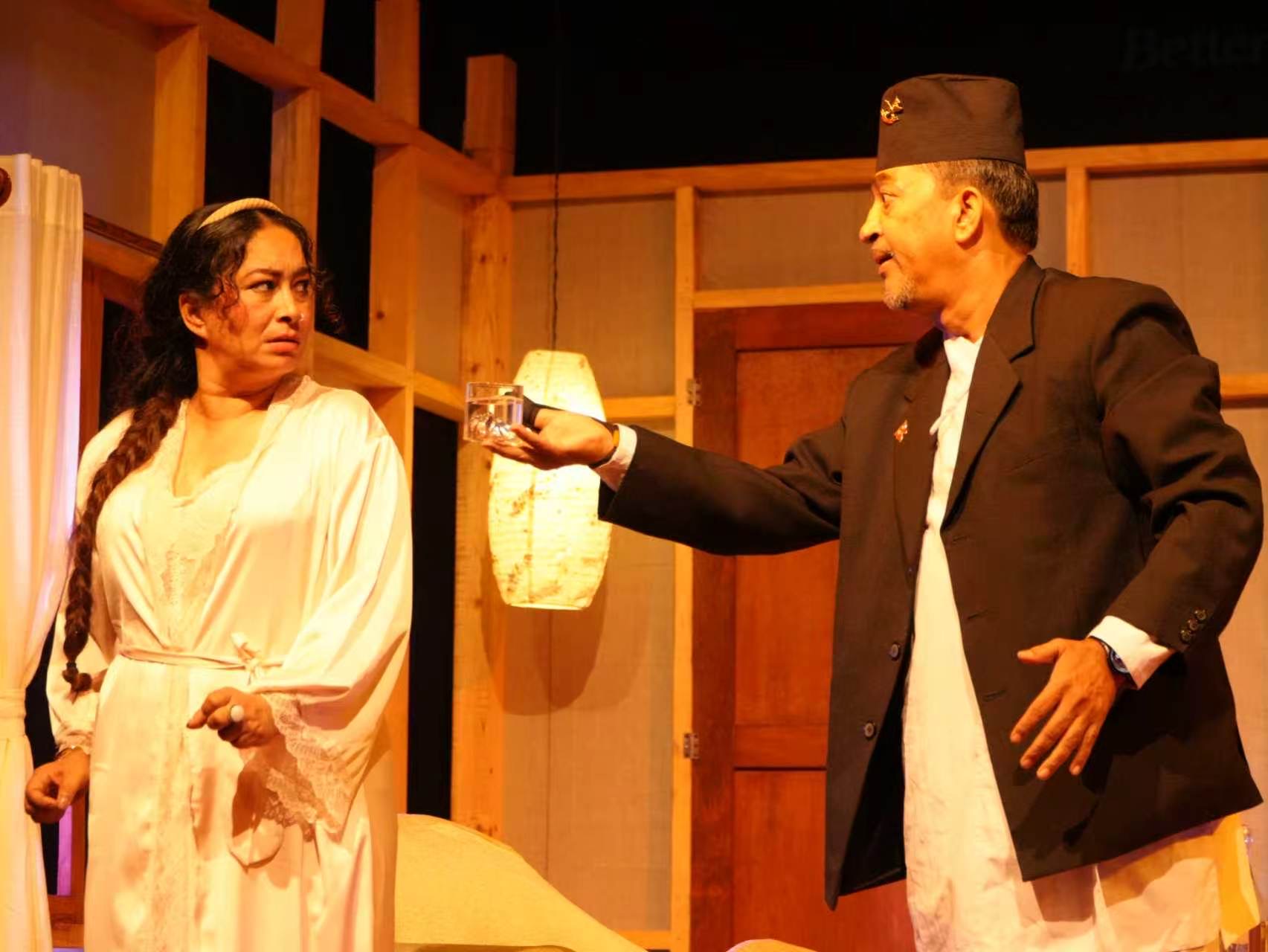
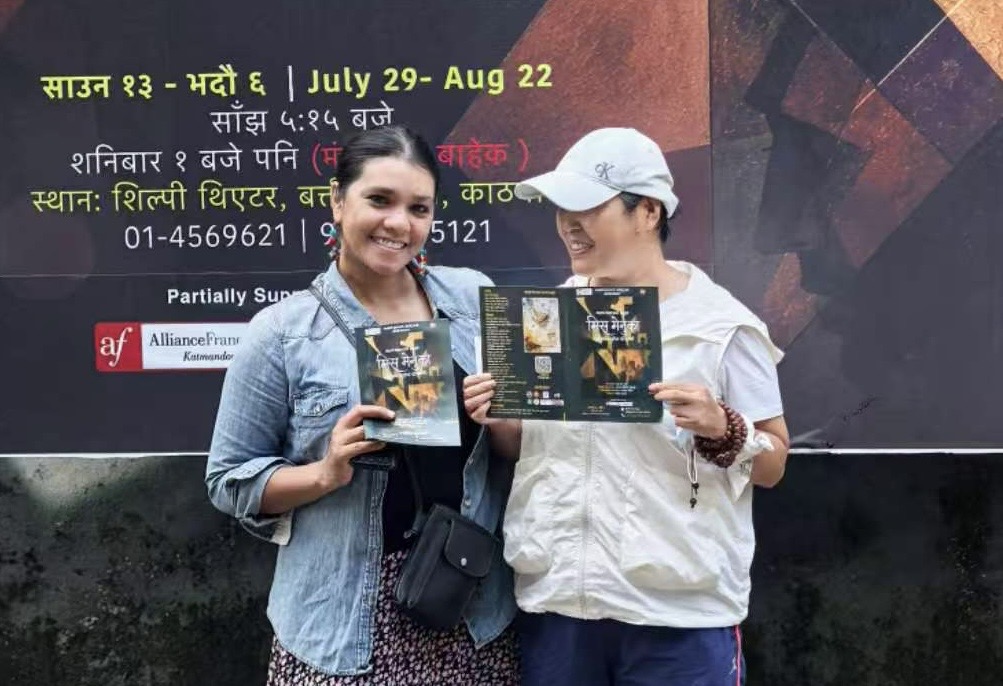
Recently, I watched Miss Menuka at Shilpee Theatre in Nepal. Directed by Pabitra Khadka, the play stars renowned artists Ghimire Yubaraj and Sarita Giri. It is adapted from The Respectful Prostitute, the landmark 1946 play by Jean-Paul Sartre, the French philosopher and giant of existentialism. Rooting Sartre’s sharp existential critique in Nepal’s cultural landscape, the work unfolds as an allegory woven within a play, posing an unavoidable question to every audience member: What is truth? And what counts as truth?
The plot itself is straightforward. Set in Kathmandu, the story follows Menuka, a sex worker, who witnesses an act of violence aboard a night bus: a Pahadi youth shoots and kills a Madhesi youth. To shield “one of their own”, the family of a Member of Parliament colludes with the police to mount systematic pressure. They alternate between bribery, threats, emotional manipulation, and grand rhetoric invoking “Mother Nepal”, all pursuing a single goal: forcing Menuka to sign a false statement framing the innocent Paswan as an attempted rapist.
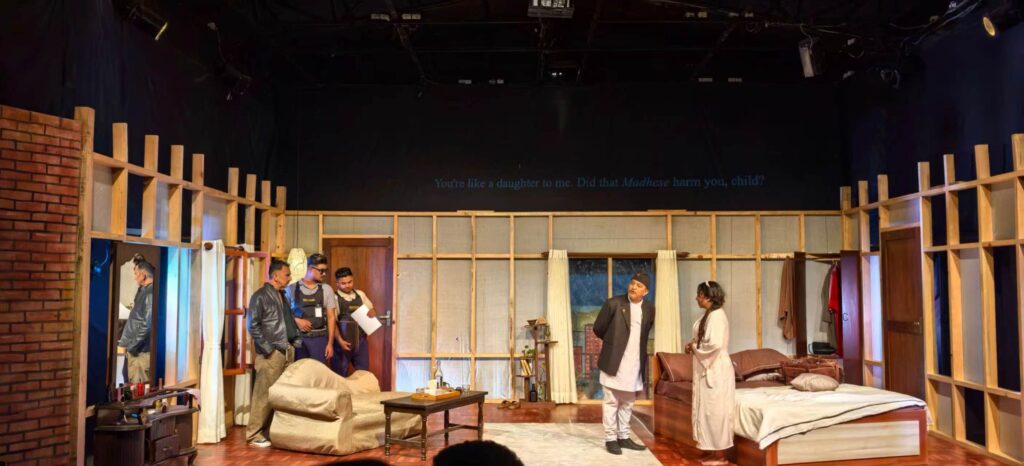
Upon the compact stage, within a shabby rented room, two camps stand opposed. On one side are the parliamentarian and police, holding power and controlling narratives. On the other stands a prostitute, dismissed as inferior, isolated, weighed down by deep social prejudice. This cramped lodging becomes the battlefield of human nature, hosting a fierce mental conflict fought without weapons. This confrontation mirrors society at large: those who hold the power of discourse can rewrite narratives at will, while the testimony and eyewitness accounts of marginalisedvulnerable people are often worth less than dust. Truth ceases to be objective fact; it becomes whatever those in power want the public to see.
When Menuka speaks the truth that Paswan, the Madhesi man, committed no murder, Bibek erupts angrily: “Truth! A prostitute not worth a thousand rupees dares to talk of truth? There is no truth here—only Pahadis and Madhesis.” Why? The ostensibly benevolent parliamentarian explains to Menuka: “Child, truth comes in hierarchies, just like people. Your version of truth will never be accepted by the public.” Here, there is no truth, no equality—only desire and prejudice.
Trapped inside this confined space, confronted with existential pressure, personal threats and unceasing intimidation, what choice will Menuka, the vulnerable underdog, make? This moment forms the dramatic climax and steers the course of the whole play.
As I watched, I thought of Lanlan and Ying’er, trapped amid desert hardships in Daughters of the Desert, a novel by Chinese writer Xuemo. In that book, Lanlan and Ying’er trek into the desert with camels to find salt ponds, hoping to change their desperate lives. Along the way, they face vicious jackals, shifting sand, and agonising thirst. The two women, hunted by “jackals”, are forced to make decisions that shape their fates. The jackals carry symbolic weight: they represent misfortune, suffering, illness, loss and parting, all hardships we must confront in life. Yet Lanlan and Ying’er differ from Menuka. Supported by hope and faith, they step by step break free from fate’s stranglehold. Their desert journey is not merely a physical crossing; it is a profound spiritual transformation.
Lanlan and Ying’er’s story unfolds in the vast, empty Gobi Desert of western China, while Menuka’s tale takes place inside a cramped Kathmandu rental room. One landscape is open and desolate, the other tight and stifling. One pair faces jackals and starvation; the other faces guns, lies and power. Fundamentally, however, they are trapped by the same predicament. Menuka’s small room is a desert in miniature. Bibek piles pressure on her with money and sexual temptation. The parliamentarian ensnares her in moral nets woven from rhetoric of “Mother Nepal”. Police threaten her with eighteen months’ imprisonment, closing in relentlessly. She has nowhere to flee, torn between signing the document and refusing. Her desert exists in her mind. Where Xuemo’scharacters face wild jackals, Menuka faces humans who act like jackals. Unlike Lanlan and Ying’er, Menuka yields to coercion from the parliamentarian and two police officers, signing the false affidavit. The moment she puts pen to paper, she chooses to play the role of a compliant subject.
Yet the play carries profound depth: Menuka’s conscience never fully dies. Once the parliamentarian leaves and she is alone in the empty room, she voices a painful awakening: “Grey hair, motherland, nation, race, language, religion—they have fooled me completely.” This constitutes an existential moment of awakening. She moves beyond being defined by an assigned role, begins to examine that role, and realises she has been acting out a script written by others.
The stage falls into complete darkness. Silence hangs outside the window. Inside the room, Menuka slumps tiredly on the bed, smoking a cigarette. The glowing ember flickers on and off, mirroring her restless, wavering heart. She cannot tell what tomorrow will bring, nor which path she ought to take.
The struggles of the characters on stage belong to all humanity. In real life, we often find ourselves standing in Menuka’s position. Within the “life script” woven by power, prejudice and desire, do we know whose role we are performing? Do we retain the courage to rewrite the prewritten lines? This is not merely a question about where women might find liberation. It is a shared dilemma for everyone crushed within what Xuemo calls “the millstone world”: how can people redefine themselves within a world that seeks to define them?
Every character in the play is acting. The vital question is: who writes their scripts? For Menuka, power writes the script. For Bibek, caste writes it. For Jagannath, ideology writes it. For Paswan, prejudice writes it. All perform roles assigned to them, reciting lines composed by others. The true tragedy is not that we play parts, but that most people never realise they have the power to rewrite the script.
We leave the theatre and step back into bustling Kathmandu’s streets, yet the drama does not end. In a profound sense, life itself is a play that invites every spectator to take part. Inside a world still saturated with lies, power, compromise and performance, do we leave with clearer vision than when we entered? Do we recognise we have long inhabited a role whose script can be questioned, torn up and rewritten?
“Life is a drama; drama is life.” The true meaning of these eight words is not merely to sigh at fate’s absurdity. It reminds us: if life is a play, rewriting the script is always possible. The only question is whether you dare to rewrite your own life’s script.
Written by Gu Zhicao (China)