Tax Relief, AI Infrastructure and Structural Reforms Dominate New Budget
Kathmandu-The Government of Nepal has unveiled an ambitious and reform-oriented budget for Fiscal Year 2083/84, placing strong emphasis on artificial intelligence, digital transformation, tax reform, infrastructure expansion and public sector restructuring.
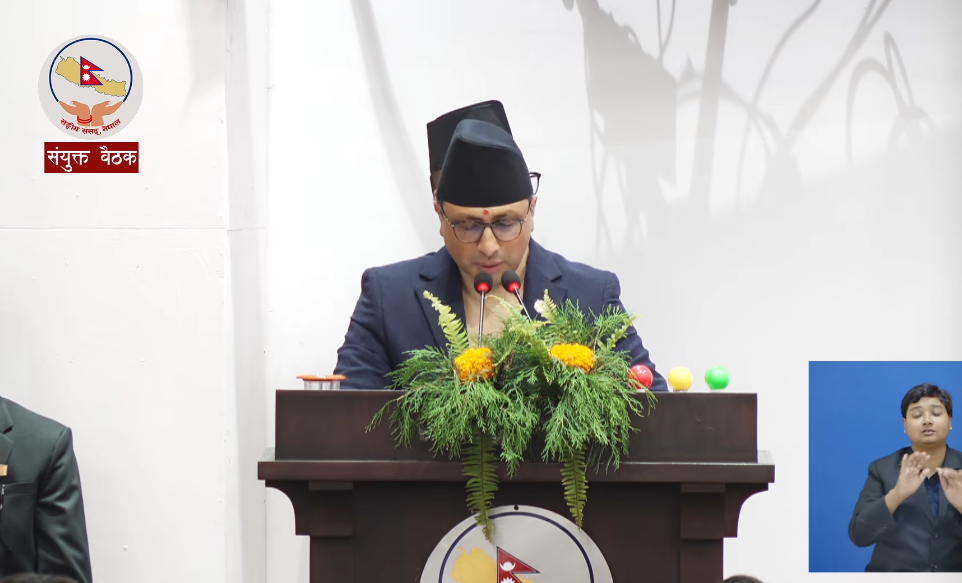
Presenting the annual budget in the joint session of the Federal Parliament on Friday, Finance Minister Swarnim Wagle announced a series of sweeping economic and institutional reforms aimed at modernizing Nepal’s economy and improving governance efficiency.One of the most significant announcements was the establishment of Nepal’s first sovereign AI Compute Center in Syuchatar, Kathmandu. The government said the facility will support artificial intelligence research, data processing and technological innovation as Nepal positions itself as an emerging regional tech hub.To further strengthen the technology sector, the government also announced plans to sell 34 percent shares of Nepal Telecom to the general public by the month of Poush. Revenue generated from the share sale will be invested in transforming Nepal into a technology and innovation hub.
The budget also introduced major income tax relief measures for individuals. The minimum annual taxable income threshold has been increased from Rs 500,000 to Rs 1 million. Individuals earning up to Rs 1 million annually will now pay only 1 percent tax.In another major reform, the government reduced customs duty slabs from 11 categories to seven. Customs duties have been lowered on 273 goods, while excise duties on 360 items have been removed altogether. The government also announced the integration of scattered border taxes into a unified green tax system.Finance Minister Wagle further announced the closure of 31 government agencies, merger of six agencies and restructuring of 18 others as part of a broader public sector reform drive. According to the government, these reforms could save nearly Rs 20 billion annually.
The budget also seeks to formalize economic activities through digital billing systems. The government plans to introduce a lottery program encouraging consumers and businesses to issue mandatory VAT bills and invoices during transactions.In the aviation sector, the government announced plans to convert Nepal Airlines Corporation into a company model and seek strategic partners to improve its management and operations.To accelerate infrastructure development, the government introduced a “Mission Mode” development model alongside a “Sunset Law” framework aimed at phasing out ineffective programs and institutions. Kathmandu Valley’s long-term “Vision Kathmandu 2040” project was also announced, including underpasses, overpasses, underground electric wiring and expansion of open public spaces.The government said public enterprises will gradually be operated under Public-Private Partnership (PPP) models following detailed asset valuation processes.In financial sector reforms, the government announced that capital gains tax on share trading will now be treated as a final tax, meaning investors will not face additional taxation after paying capital gains tax.The government also introduced a special settlement mechanism for pending tax disputes in courts and judicial bodies. Taxpayers paying the principal amount plus one percent within a specified deadline will receive waivers on penalties, interest and late fees.
The budget allocates Rs 286 billion for roads and urban infrastructure, including blacktopping of 1,000 kilometers of roads and construction of 200 bridges next fiscal year. Another Rs 70 billion has been earmarked for transmission lines and substations.The government has allocated Rs 218.3 billion for education and Rs 120 billion for social security programs. Health insurance reforms will also be undertaken, with Rs 15 billion allocated to the health insurance program.In labor reforms, the government announced that wage fraud, labor exploitation and violation of labor agreements will be treated as economic crimes. Written labor contracts, minimum wage compliance, insurance and bank-based salary payments will be made mandatory.
Tourism development also received priority, particularly in Sudurpashchim Province where the government plans to connect Ramaroshan, Khaptad, Badimalika, Shaileshwari, Ugratara and Malikarjun under an integrated tourism development project.Finance Minister Wagle claimed Nepal’s macroeconomic indicators are improving due to political stability, stronger foreign exchange reserves and sufficient liquidity in the financial system. He said Nepal stands at a decisive point for broader economic reforms driven by clean energy, technology and investment promotion.