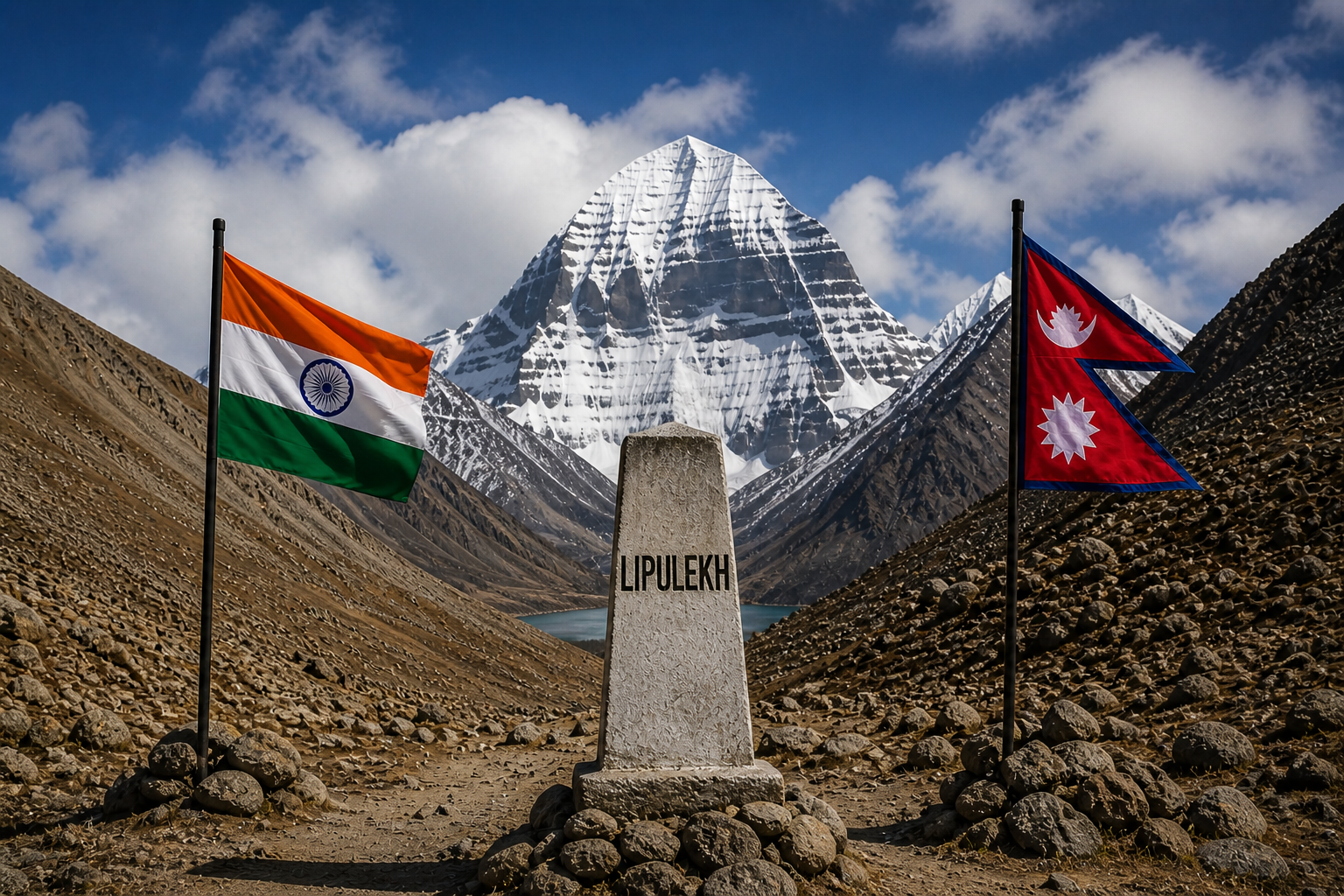
Kathmandu: The Government of India has once again reiterated its position regarding the use of the Lipulekh Pass for the Kailash Mansarovar Yatra, following Nepal’s recent objection to the pilgrimage route being operated through the disputed area.
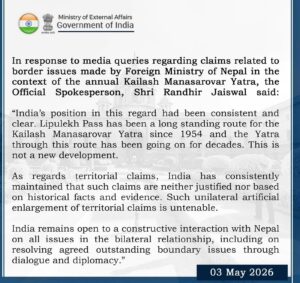
In a statement issued on Sunday, the Ministry of External Affairs maintained that the Lipulekh Pass has been in use for the Kailash Mansarovar Yatra since 1954, emphasizing that the current development is not new. Spokesperson Randhir Jaiswal stated that India does not consider Nepal’s territorial claims to be supported by historical facts and evidence.
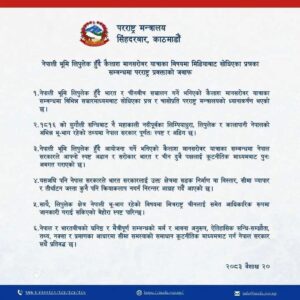
“Unilaterally expanding territorial claims is not practically acceptable,” the statement noted, while also expressing India’s willingness to resolve outstanding border issues through constructive bilateral dialogue.The response came after Nepal’s Ministry of Foreign Affairs issued a formal statement expressing concern over India and China reopening the Kailash Mansarovar Yatra via Lipulekh without Nepal’s involvement. The ministry reaffirmed that Lipulekh, along with Limpiyadhura and Kalapani, lies within Nepali territory as per the Sugauli Treaty.
According to the ministry, Nepal has consistently urged India to refrain from activities such as road construction, trade, or pilgrimage in the disputed region and has formally communicated its position to both India and China.
The clarification from Kathmandu came hours after media reports questioned the government’s initial silence. The government led by Balendra Shah made its position public through a six-point statement later in the evening.Earlier, India had announced on April 30 that it would facilitate the Kailash Mansarovar Yatra from June to August 2026 via both Lipulekh Pass and Nathula Pass in coordination with China. India plans to send a total of 1,000 pilgrims, evenly divided between the two routes.
The development has raised concerns in Nepal’s diplomatic circles, particularly as Nepal was neither included nor formally informed, despite prior agreements between India and China in 2015 and as recently as August 2025 during the visit of Chinese Foreign Minister Wang Yi to India.Former Foreign Minister Pradeep Gyawali criticized the government’s initial silence, stating that it could weaken Nepal’s position on border issues. Former Ambassador to India Nilambar Acharya stressed the need for Nepal to clearly communicate that its territory cannot be used without consent. Likewise, former Ambassador to China Tanka Karki called for evidence-based diplomatic engagement, while border expert Buddhinarayan Shrestha attributed the escalation to weak diplomatic handling.
The issue of Lipulekh remains a sensitive trilateral concern, with Nepal reiterating its sovereignty claims and calling for resolution through diplomatic channels.