
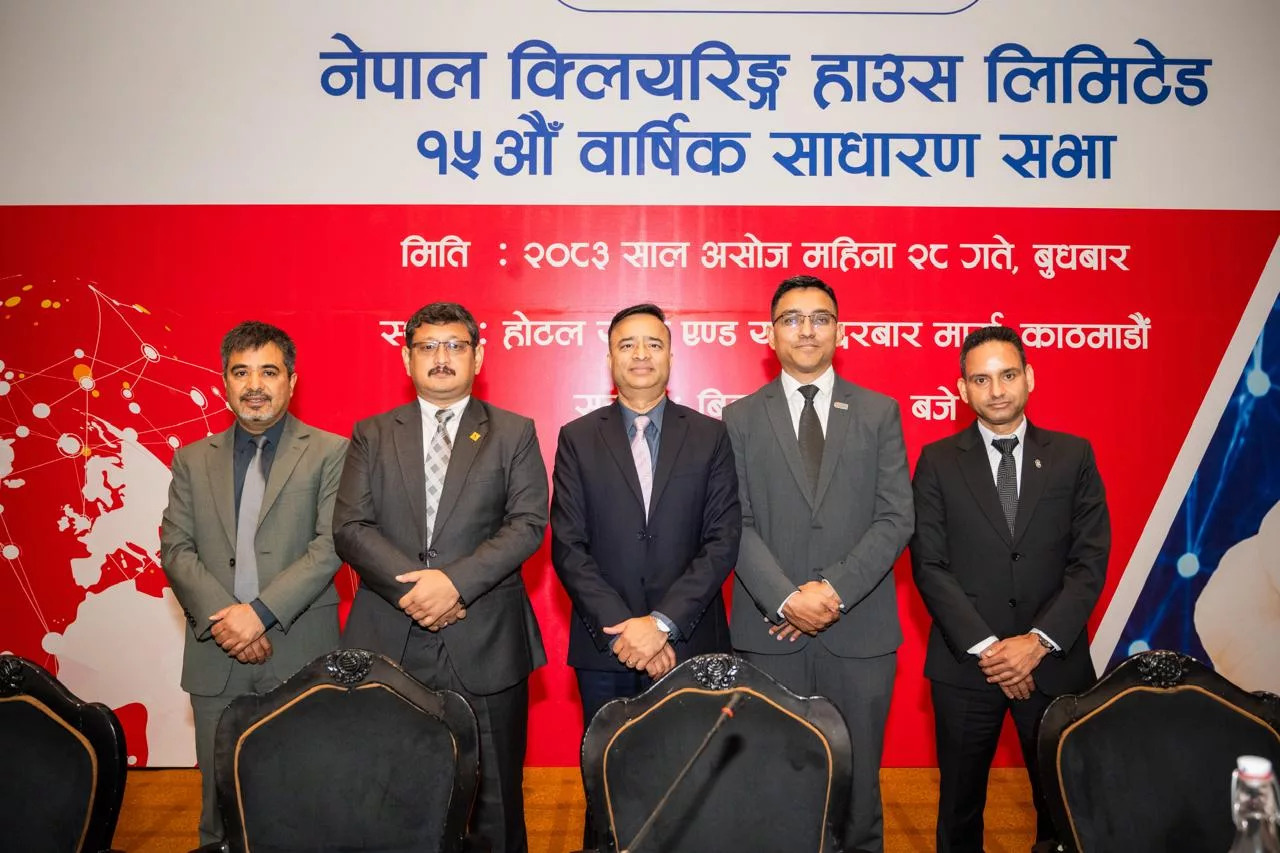
Kathmandu — Nepal Clearing House Limited (NCHL) has completed its 15th Annual General Meeting (AGM) for fiscal year 2082/83, approving its financial statements and a 15% bonus share distribution, along with a 0.789474% cash dividend for tax purposes.
The AGM approved the company’s audited balance sheet, profit and loss statement, and cash-flow statement up to the end of Ashadh 2083. Following the bonus share issuance, NCHL’s paid-up capital will reach Rs 1.67 billion.
NCHL said the increased capital will be used to strengthen national payment systems, develop additional payment infrastructure for domestic and cross-border transactions, expand infrastructure for digital public infrastructure, improve risk management and upgrade existing systems.
During fiscal year 2082/83, NCHL’s payment systems processed 238.2 million transactions worth around Rs 210 trillion. The number and value of transactions increased by 13% compared with the previous fiscal year, while the company’s operating income grew by 7%.
Despite the growth in transaction activity and operating income, NCHL reported a net profit of Rs 410 million, which was around 2% lower than the previous fiscal year.
The AGM also authorized NCHL’s Board of Directors to begin the necessary process to establish a separate public limited company as a subsidiary or affiliated company. The proposed company will focus on research, development, installation and related work involving technology and software for banking, financial services and payment systems.
NCHL currently operates major payment infrastructure including NCHL-ECC, NCHL-IPS, EFT Card Switch and the National Payment Switch (NPS), including NPS-NCS/RPS, NPI and NPIx. It also operates payment platforms and instruments such as connectIPS, CORPORATEPAY, connectRTGS, NEPALPAY QR and NEPALPAY Card.
The company currently has 53 member banks and financial institutions, including Nepal Rastra Bank, along with more than 150 non-banking institutions connected as indirect or technical members.
NCHL is owned 9.45% by Nepal Rastra Bank and 90.55% by banks and financial institutions, reflecting its central role in Nepal’s national payment infrastructure.
Photo Source: RatoPati