A New Political Economic Discourse
As a graduate student at Tribhuvan University’s Central Campus, I had the invaluable opportunity to study and observe firsthand the workings of political economy, cultural dynamics, political party governance, and student politics in the broader process of state‑building. I also examined the dynamism of firms and their critical role in advancing both economic growth and jobs creation. At the same institution, I engaged with courses on education systems and economics. Faculty members often emphasized that without a serious grounding in economic thought, one could scarcely claim to be a competent economist or policy practitioner. My interactions with colleagues from the Central Department of Economics in Kirtipurfurther revealed the breadth of courses in economic thought, including Marxist perspectives. Across public universities worldwide, many scholars continue to argue that Marxist economics provides a foundational lens for analyzing income distribution, production, interest, rent, and the broader relationship between society and the state what we might call the public economy.
During my research on agricultural value chains, access to finance, and gender economics, I observed debated on public economic, investment discussions, and global perspectives on development were reflected in contemporary media, literature, and reports. In recent years, we have all witnessed widespread praise for China’s remarkable progress in science, technology, infrastructure, and industrial efficiency. Yet, the Congressional Research Service of the U.S. Government noted in 2019 that China’s large‑scale purchases of U.S. Treasury securities totaling $1.1 trillion as of April that year enabled the federal government to finance budget deficits and maintain relatively low interest rates.
Historically, China under Chairman Mao Zedong maintained a centrally planned economy, with the state directing production, controlling prices, and allocating resources. Since 1979, however, China has pursued reforms that defy simple categorization. Much of global discourse remains trapped in binary frames capitalism versus socialism, free market versus state control, liberal democracy versus authoritarianism. This conceptual prison often obscures the reality of political systems that transcend such categories. Modern China exemplifies precisely this transcendence. Its model does not neatly fit Western definitions of capitalism or socialism, nor does it claim to offer a universal template. Instead, it represents a pragmatic synthesis: a civilizational state navigating modernization through robust party governance that combines market dynamism with strategic state direction, long‑term planning with social stability. This synthesis has delivered unprecedented growth and poverty reduction, while simultaneously challenging the foundational assumptions of Western‑centric political and economic though.
The Economic Synthesis: Beyond State vs. Market
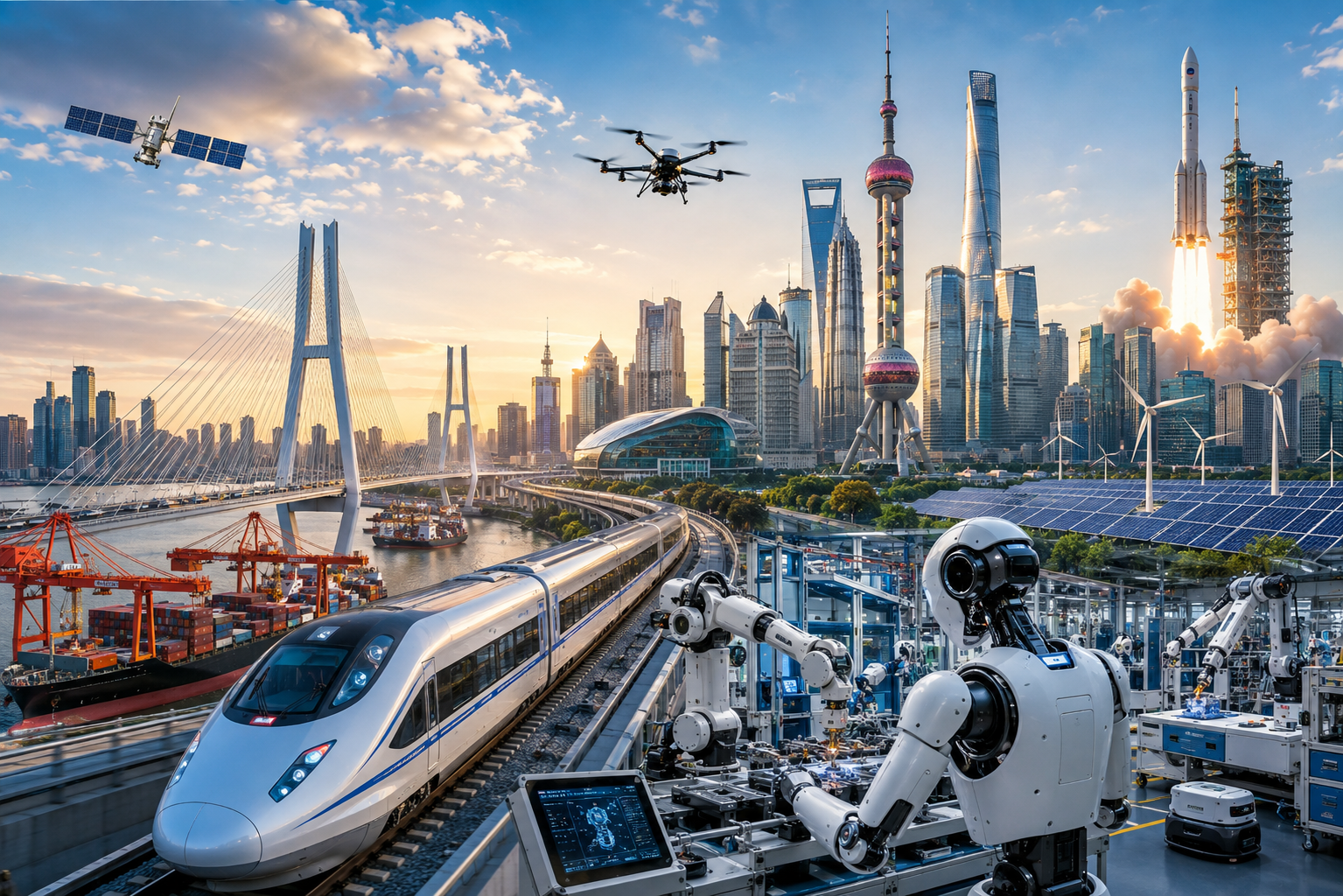
The defining feature of China’s development strategy is its strong, resilient economic model. In Western discourse, the economy is often portrayed as a zero‑sum contest between state and market. In China, however, these forces are not adversaries but complementary pillars of a broader inclusive developmental vision. The market is permitted to play a “decisive role” in resource allocation, meaning that prices, supply, and demand are largely shaped by competitive forces. This has fueled innovation, created the world’s largest middle‑income group, and integrated modern China deeply into global value chains. At the same time, the state exercises a powerful “visible hand,” not to replace the market but to correct failures and align growth with strategic national objectives. This is evident in ambitious industrial policies, massive infrastructure investments, and targeted support for sectors such as artificial intelligence and green technology, where market incentives alone might underdeliver. Rather than the pejorative label of “state capitalism,” this model represents a sophisticated synthesis: state‑owned enterprises serve as strategic anchors, while private firms drive entrepreneurial vitality. By combining long‑term planning with market dynamism, China has orchestrated the largest poverty‑reduction program in human history, lifting more than 800 million people out of destitution. This achievement challenges neoliberal assumptions that market forces alone can resolve systemic inequality and social injustice.
China’s both party and government governance system, rooted in party leadership and community‑level engagement, has advanced economic empowerment by expanding opportunities for people of all walk of lives in markets and enhancing people’s agency and functionings. Access to health care, education, employment, energy, sports and vocational training, etc. reflect broader human development dimensions that distinguish China’s model from conventional market economies. Comparative indicators underscore this divergence. As of mid‑2026, unemployment rates stand at 5.0% in China, 5.1–5.2% in India, and 4.2–4.3% in the United States. The Food Security Index (0–10 scale) shows China at 7.62, the U.S. at 7.03, and India at 5.31, with climate change projected to erode all three; India most severely. The Health Access Services Index places the U.S. at 68–74/100, China at 61.5/100, and India at 44.5/100. The Education Index records the U.S. at 82.4, China at 80.9, and India at 60.1. According to World Bank data (2025–2026), the U.S. remains the largest economy with a nominal GDP of about $30.8 trillion, followed by China at $20.9 trillion and India at $4.1 trillion. Yet GDP alone does not capture prosperity. Broader indicators; food security, health access, education, employment, and well‑being; reveal that China’s hybrid model of state guidance, party governance, and market dynamism has lifted millions from poverty, while the U.S. continues to lead in per capita wealth and innovation. Together, these examples remind us that GDP measures scale, but not the full depth of human progress.
Governance and Political Legitimacy
China’s party and government governance model rests on a logic distinct from Western liberal democracies. In the West, legitimacy is often equated with electoral competition and multi‑party systems. In China, legitimacy derives from performance like knowledge, vision, and integrity. The Communist Party’s authority is rooted in its ability to govern effectively, deliver sustained economic growth, and ensure that the fruits of development are distributed fairly, advancing social justice and reducing inequality. This approach is embodied in “whole‑process people’s democracy.” Unlike systems that reduce democracy to periodic elections, China embeds participation throughout governance from remote village committees to national congresses. Deputies hear citizen complaints, conduct inspections, and coordinate solutions, such as repairing roads or improving localhuman social-economic services. This problem‑solving orientation avoids the partisan gridlock common in Western democracies. It also ensures policy continuity, enabling long‑term planning in areas like infrastructure, technology, and poverty reduction. Independent surveys, including those by Harvard’s Ash Center, consistently report high public confidence in Chinese governance, reinforcing the idea that legitimacy can rest on performance as much as procedure.
A Reference, Not a Blueprint for the Global South
China does not present its model as a universal template. Instead, it demonstrates that modernization is diverse and not bound to Western prescriptions. For countries like Nepal and India, where political systems remain fluid and coalition governments often struggle with continuity, China’s experience offers a reference point. It shows that economic advancement and social stability can be achieved without neoliberal austerity or external dependency or debt syndrome. The “socialist market economy” illustrates how market mechanisms can coexist with state direction, preventing fragmentation and inequality.Modern China challenges the binary of socialism versus capitalism. By combining market dynamism with state foresight, it has reshaped global discourse. For Nepal, India, and the wider Global South, the lesson is clear: prosperity and dignity need not follow a single Western path, but can be pursued through models rooted in local history, culture, geography, demography and sovereignty.
 Written by : Sapana Aryal