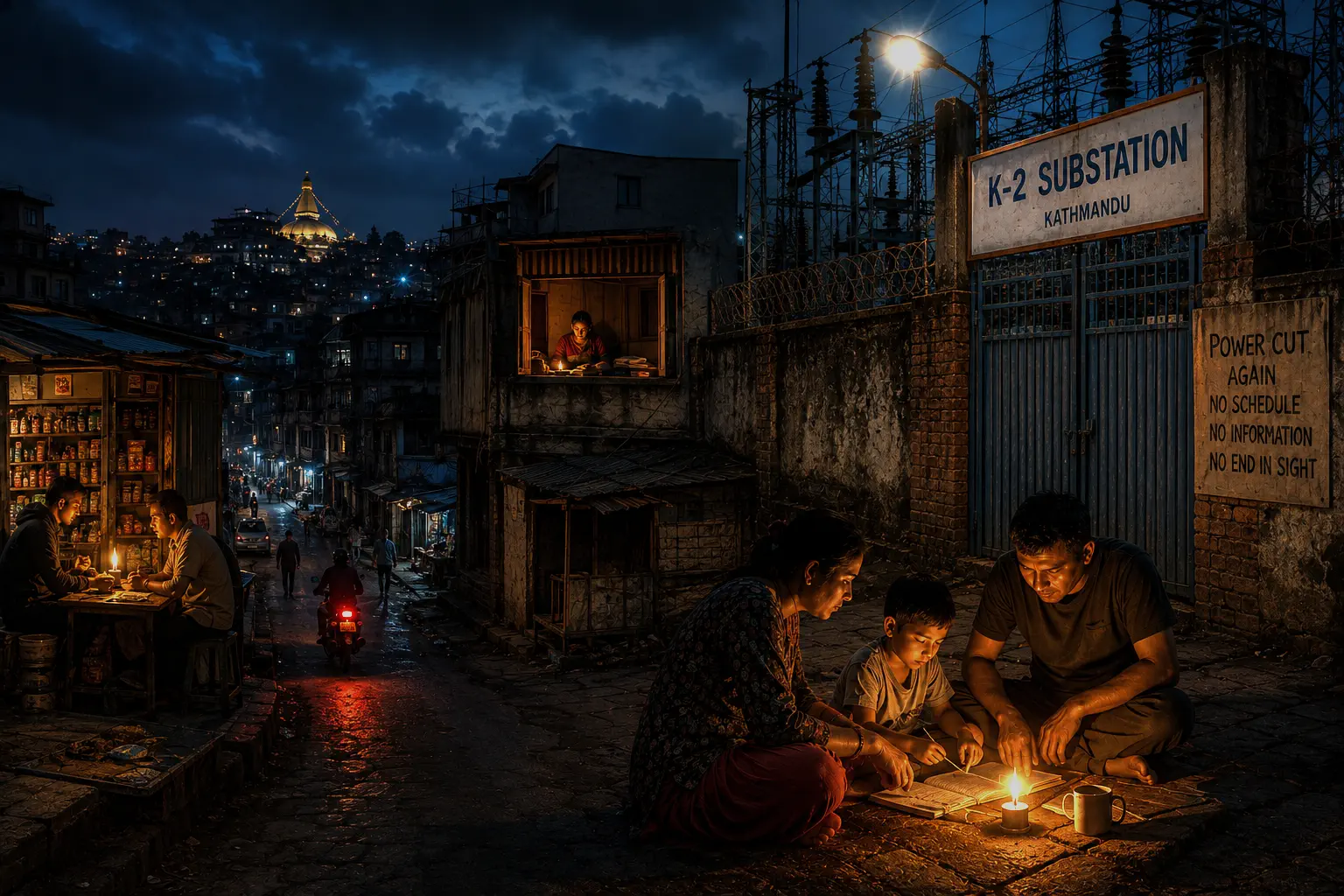
On a narrow, brick-paved galli just off the bustling courtyards of inner Kathmandu, the thin morning light barely trickled through the small window of a ground-floor room.
Sanu Maiya poured the rinsed rice into the cooker, flipped the switch to Cook, and turned to fetch the lentils.
Then, “Jhyapp!”.
“Not again,” Sanu Maiya sighed, setting down the pot of lentils with a heavy thud.
Babu Raja, working as a contract gardener in the local public office, hurried over to the entryway. “The MCB is fine, Sanu,” he called back, his brows furrowed. “Our house breaker didn’t trip.” Determined to trace the culprit, Babu Raja burst through the front door, and ran into the alley shouting, “What happened? Why did the power go out again?”
A cluster of neighbors had already gathered near the corner tea stall, shaking their heads under a chaotic tangle of thick black cables drooping dangerously low from a rotting wooden pole. “Don’t bother checking your house, Babu Raja!” one of them, who had worked in Nepal Electricity Authority as an electrician, called out. “The breaker in K-2 substation tripped again.”
Old Asha Kaji, sitting on end of a wooden bench with a half-empty cup of black tea, spat onto the dirt road and scoffed. “It’s classic Nepali management. They buy substandard, cheap equipment from shady contractors, pocket the commission, and leave us with a distribution grid held together by electrical tape and hope.” He came in closer, his voice dropping to an angry whisper. “They trip the breaker every morning when the neighborhood load spikes because the infrastructure is twenty years outdated—and nobody in charge gives a damn.”
Ramcha, the local youth political activist, leaned in toward Babu Raja. He cast a quick, suspicious glance down the alley before leaning closer, whispering under his breath, “You don’t know? It’s not an accident, my friend. It’s the opposition party. They’re messing with the grid to make the current local administration look incompetent.”
Babu Raja sighed, glanced at his watch—8:15 AM. He hurried back inside, where Sanu Maiya was staring glumly at the pot of cold, hard rice sitting half-cooked, soaked in lukewarm water—neither raw nor edible.
She pulled down a plastic container of chiura, poured a generous handful into a metal bowl and topped it with a spoonful of last night’s leftover potato curry.
Babu Raja took the bowl. Eating dry beaten rice wasn’t the warm, comforting dal bhat Sanu Maiya usually cooked for him, but as he scooped up the first mouthful, he smiled at his wife. It was fast, simple, and reliable—everything the local power grid was not.
With a final nod, Babu Raja finished the bowl, drank a glassful of water, wiped his mouth, and stepped out into the morning sun—fueled by beaten rice and ready to work in a town running on broken promises.