Journalism Under Pressure, Democracy at Risk
Kathmandu-Every year on May 3, the world observes World Press Freedom Day, a day not only to celebrate journalism, but also to question whether truth itself is still safe. Established by UNESCO in 1993 following the historic Windhoek Declaration of 1991 in Namibia, the day stands as a global reminder that freedom of expression is not a privilege given by states, but a fundamental human right that democracy depends upon.
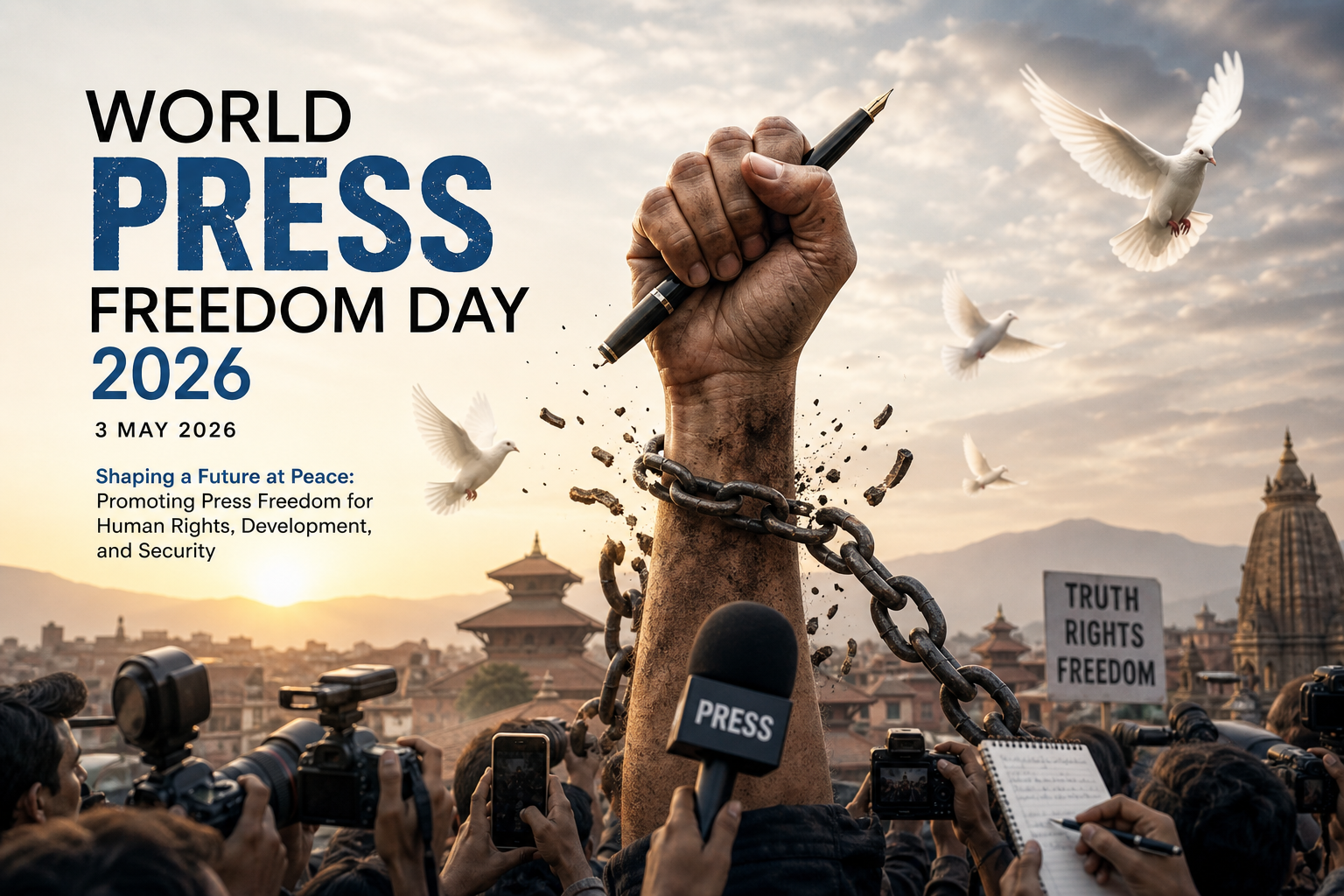
This year’s theme “Shaping a Future at Peace: Promoting Press Freedom for Human Rights, Development, and Security” arrives at a time when journalism across the world is under extraordinary pressure. From war zones to democracies, from conflict reporting to environmental investigations, journalists are increasingly becoming targets for simply doing their work.
Across Gaza, Ukraine, Sudan, Lebanon, and other conflict regions, reporters have been killed while documenting war and humanitarian suffering. International media watchdogs continue to warn that press jackets and cameras no longer guarantee safety. Journalists are surveilled, imprisoned, threatened online, forced into exile, or killed for revealing truths that powerful actors would rather hide.
But the danger is no longer limited to war zones.Even in democratic countries, journalism faces a quieter but equally dangerous form of suppression digital harassment, political intimidation, censorship through pressure, coordinated online abuse, legal threats, economic insecurity, and public distrust fuelled by misinformation. Social media, once considered a tool for democratizing voices, has increasingly become a weapon used to silence independent reporting.
In Nepal, the situation reflects this global crisis in deeply local ways.Nepal’s media landscape has expanded significantly after the restoration of democracy. Independent journalism has exposed corruption, amplified marginalized voices, documented human rights abuses, and held those in power accountable. Yet behind this progress lies a difficult reality many journalists quietly endure every day.
During Nepal’s conflict era, journalists reported between the violence of the state and armed groups. Many were threatened, disappeared, tortured, censored, or killed. Journalists like Uma Singh, Krishna Sen, and Dekendra Raj Thapa became symbols of the dangerous price of truth-telling in Nepal. Even after the end of the conflict, impunity continues to haunt the profession.
Today, the pressure may appear different, but it has not disappeared.Journalists covering sensitive issues corruption, land politics, environmental destruction, cooperative fraud, marginalized communities, or the struggles of sukumbasi settlements frequently face attempts to block reporting. Sometimes the pressure is subtle. Sometimes it is direct.
Recently, while attempting to report from a holding center where displaced Sukumbasi residents were being kept, journalists were reportedly stopped by guards and informed that “journalists are not allowed inside” due to “orders from above.” Reporters who questioned the restriction were denied access. According to media workers present at the site, some journalists from other outlets were allegedly forced to delete photographs and videos they had captured. Even residents inside the holding center who uploaded videos and images to social media were reportedly questioned aggressively about who shared the content.
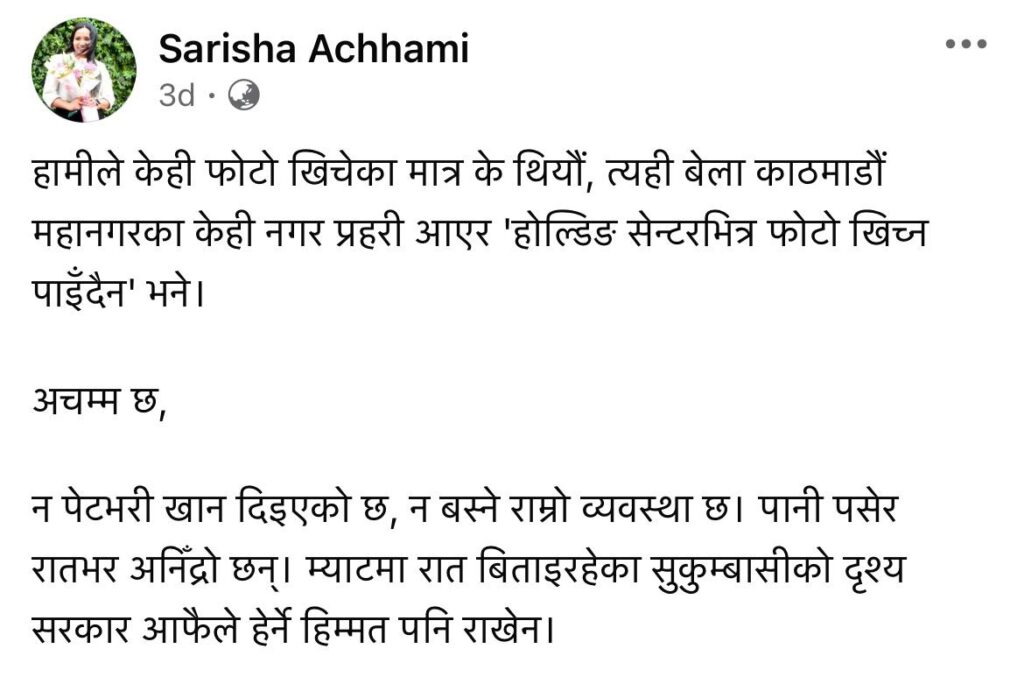
A Setopati journalist, Sarisma Achhami, shared her experience of reporting from a Sukumbasi holding centre, where she was asked to delete photos taken with consent.
When journalists are prevented from witnessing state actions, when cameras are stopped from recording reality, and when citizens themselves are discouraged from speaking publicly about their condition, the issue becomes larger than one story. It raises serious questions about transparency, accountability, freedom of expression, and the public’s constitutional right to information.
The danger journalists face is not only institutional it is also physical.
Photojournalists and field reporters often stand at the frontline of protests, disasters, political unrest, and public violence with little protection. They are expected to document chaos while simultaneously becoming vulnerable to it.
The killing of Video journalist Suresh Rajak during the March 28, 2025 protest in Kathmandu shook Nepal’s media fraternity. Rajak, associated with Avenues Television, was burned alive while reporting from a building in Tinkune that was set on fire during violent pro-monarchy protests. He had entered the area carrying only a camera not a weapon.
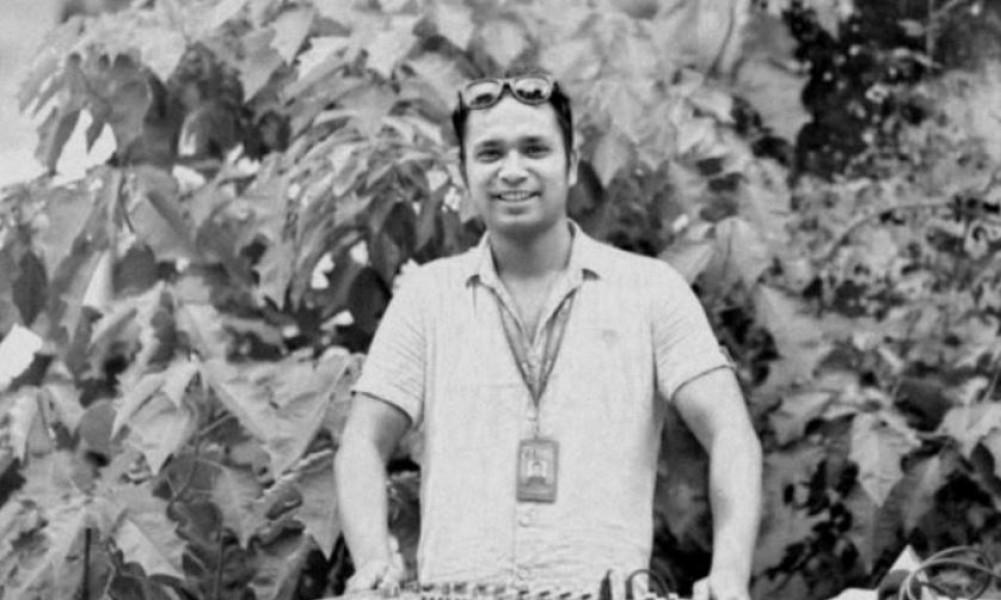
video journalist Suresh Rajak, of Avenues Television, who was killed while covering the March 28, 2025 protest in Kathmandu during violent pro-monarchy demonstrations in Tinkune.
Several journalists were also injured during the same protest while performing their duties. Shyam Shrestha, a video journalist with Kantipur Television, was shotDuring GenZ protest in the arm by a rubber bullet while filming near New Baneshwar.
Dipendra Dhungana, a photojournalist with Naya Patrika Daily, sustained injuries below his ear while covering the protest.
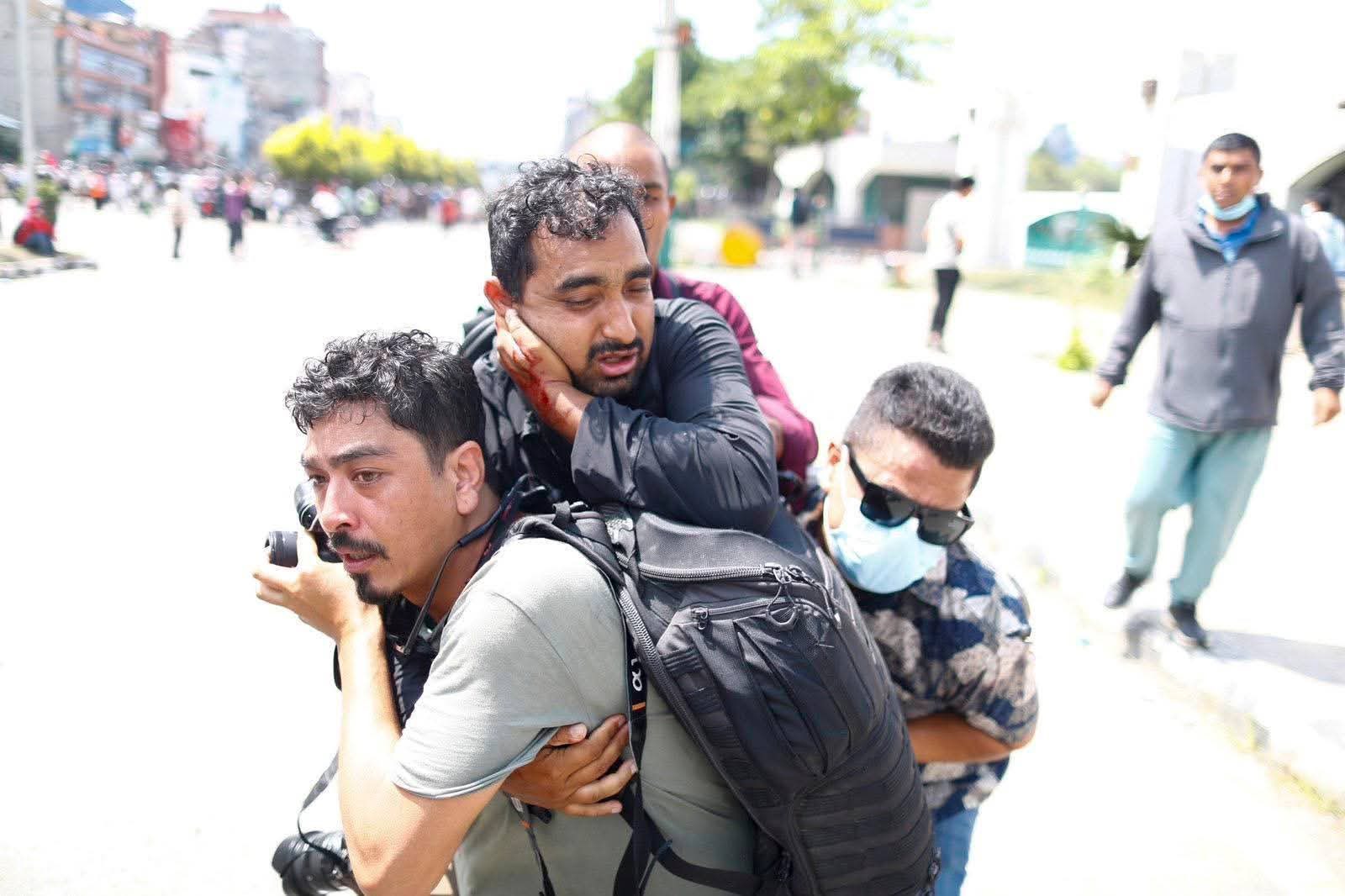
Photojournalist Dipendra Dhungana of Naya Patrika Daily, who sustained injuries below his ear while covering the protest.
Umesh Karki of Nepal Press was also shot in the arm, while Shambhu Dangal reportedly suffered injuries in his left leg from a metal bullet.
These incidents reflect a painful reality: journalists documenting unrest increasingly become victims of the same violence they are covering.
The murder of young journalist Suresh Bhul in Kailali further exposed how vulnerable local journalists remain. Bhul was reportedly beaten to death by a mob in November 2024 after being accused of goat theft allegations his family and fellow journalists strongly rejected. According to journalists familiar with the case, Bhul had been vocal about local irregularities and transparency issues. His killing raised disturbing concerns about mob violence, misinformation, and the targeting of outspoken journalists in smaller communities where legal protection is often weakest.
At the same time, journalism in Nepal remains financially fragile. Many media workers continue to work without secure contracts, fair salaries, insurance, or institutional protection. According to press freedom reports and journalist associations, delayed salaries, lack of appointment letters, political influence, and unsafe working conditions remain common across media houses.
This economic vulnerability directly affects editorial independence.
Journalists are expected to remain neutral and ethical, but survival itself has become difficult. Many reporters quietly admit that maintaining complete independence becomes challenging when livelihood depends on political connections or institutional patronage. Ethical journalism demands accountability from power, yet journalists themselves often work under systems that punish dissent internally.
Women journalists face even greater challenges. Sexual harassment, online abuse, gender discrimination, unequal pay, character assassination, and safety concerns continue to push many talented women out of the profession. Female reporters covering politics, protests, or crime are often judged not by their work, but by misogynistic narratives targeting their identity and personal lives.
Meanwhile, the rise of sensationalist online content and unregulated “YouTube journalism” has blurred public understanding of journalism itself. Today, many assume journalism is simply carrying a camera and microphone. The distinction between verified reporting and unchecked content creation has weakened. Algorithms reward outrage faster than accuracy. Rumours spread quicker than fact-checking. As misinformation expands, professional journalists increasingly face public distrust created by content ecosystems they do not control.
In this atmosphere, journalists often find themselves trapped between angry citizens and defensive authorities.
Ordinary citizens accuse media of bias. Political actors brand critical journalism as anti-government. Journalists questioning those in power become targets of coordinated abuse online. Social media attacks increasingly extend beyond reporters themselves toward their parents, spouses, and families. Recent incidents involving senior editors and investigative journalists in Nepal including targeted abuse against journalists like Kishor Shrestha show how digital intimidation has become normalized.
And yet, despite these pressures, journalism continues.Because journalism is not merely a profession. It is public service.A free press is not an enemy of the state; it is a safeguard against abuse of power. When journalists are silenced, citizens lose access to truth. Without reliable information, democracy weakens. Fear replaces accountability. Propaganda replaces public debate.This is why World Press Freedom Day matters.
It is not only about journalists. It is about every citizen’s right to know. It is about protecting truth in an age of manipulation, misinformation, artificial intelligence, surveillance, and polarization. It is about ensuring that those who question authority are not punished for doing so.Journalists are not above criticism. Media institutions must also reflect on bias, sensationalism, and ethical failures. But criticism can never become justification for violence, censorship, intimidation, arrests, or suppression.The struggle for press freedom belongs to everyone governments, civil society, institutions, and citizens alike.Because the question remains urgent, If those who speak truth are silenced today, who will speak for the public tomorrow?
At the same time, journalism itself must also reflect inward. Media cannot demand accountability from others while ignoring sensationalism, political alignment or ethical failures within its own profession. Ethical journalism must continue to prioritize accuracy, humanity, independence and public responsibility.
The rise of artificial intelligence has added another layer of uncertainty. Deepfakes, misinformation campaigns, automated propaganda and identity theft threaten the credibility of authentic journalism. Around the world, journalist unions and press freedom advocates are now demanding stronger regulations to ensure AI supports ethical reporting rather than replacing truth with manipulation.
The theme of World Press Freedom Day 2026 – “Shaping a Future at Peace: Promoting Press Freedom for Human Rights, Development, and Security” therefore carries urgent meaning.
Peace is not possible without truth. Development is not sustainable without transparency. Security cannot exist where journalists are silenced.Press freedom is not only about protecting journalists. It is about protecting every citizen’s right to know. Because when journalists are attacked for asking questions, democracy itself begins to bleed. As journalists continue reporting from protests, conflict zones, disaster sites, courtrooms, villages, and streets often without protection, without certainty, and sometimes without safety the demand remains simple: let the press do its job.
And maybe today’s generation of journalists expresses that reality best in the language of resistance itself :
“Malai bolna de sarkar, aparadh haina man kholna de sarkar.
Man kharab chaina, sahi bolna daraudina,
Kanun po lagcha ki awaaj uthaudaima…”
Because asking questions is not a crime. Speaking truth is not rebellion. Holding power accountable is not anti-state.